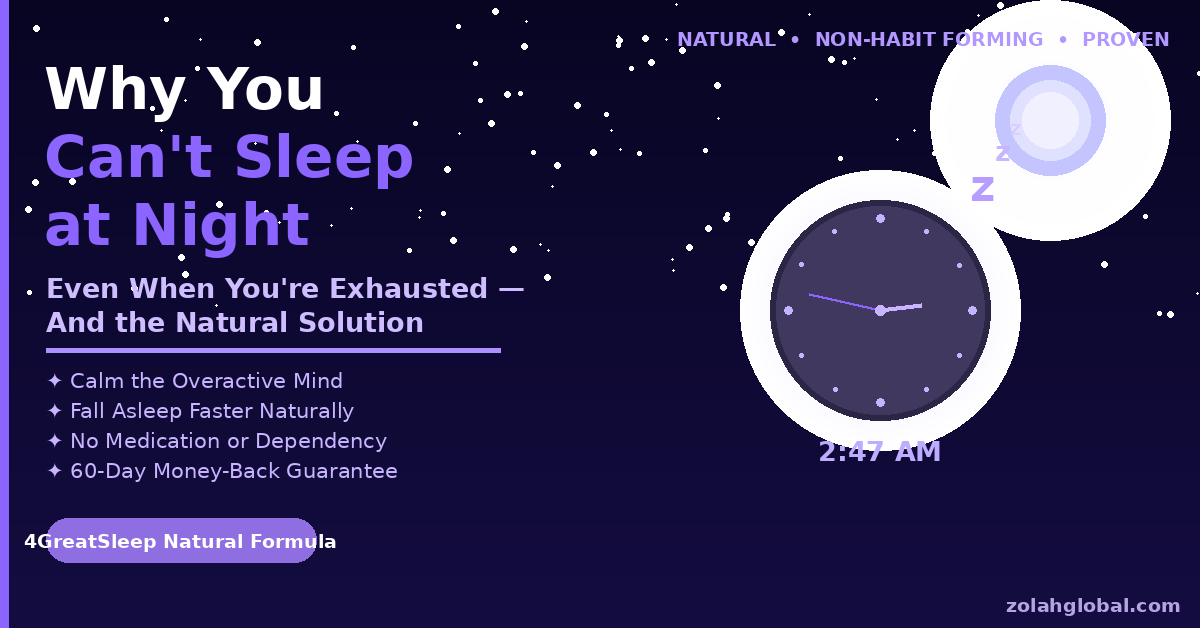
If you can’t sleep at night even when you’re completely exhausted, you already know how maddening it feels. Your body is desperate for rest — but the moment your head hits the pillow, your mind switches on. Millions of people can’t sleep at night not because of caffeine or screens, but because of something deeper that most sleep solutions never address.
It replays the conversation you had at work. It rehearses tomorrow’s challenges. It calculates bills, scrolls through worries, revisits things you can’t change and anxieties about things that haven’t happened yet. You try to force it to stop — and the trying makes it worse.
This is not a character flaw. It is not a medical mystery. And it is not something you simply have to accept.
Millions of people experience exactly this every single night — the frustrating, draining cycle of physical exhaustion meeting mental overactivity at bedtime. And most of them are looking for a solution in entirely the wrong place.
Exhausted Every Day But Wide Awake Every Night? Your Brain — Not Your Body — Is the Problem
The most common cause of chronic poor sleep isn’t caffeine, screen time, or an old mattress. It’s an overactive mind that never receives the signal to stand down. And most sleep solutions completely ignore it.
Formulated specifically to address nighttime mental overactivity — not just physical restlessness — so you can fall asleep faster, stay asleep longer, and wake up feeling genuinely restored. With a 60-day money-back guarantee, there is no risk to trying it tonight.
The Real Reason You Can’t Sleep — And Why It’s Not What You Think
Most people assume their sleep problems are caused by one of the usual suspects: too much coffee, too much screen time, a bad mattress, or simply getting older. And while these factors can contribute, they rarely explain the full picture.
Here is what the research consistently shows: the primary driver of chronic sleep difficulty for most people is an overactive, stress-activated brain that cannot downregulate at bedtime.
Your brain is biologically designed to protect you from threats. When it detects stress — even low-level, everyday stress — it stays in a heightened state of alertness, flooding your system with cortisol and keeping your prefrontal cortex active. This is an excellent survival mechanism.
It is a terrible sleep companion.
Enter for a Chance to Go to the World Cup!

The result is the phenomenon most poor sleepers know intimately: you feel physically wrecked, but mentally wired. Your body is desperate for rest. Your brain is scanning for problems, replaying conversations, constructing worst-case scenarios, and absolutely refusing to power down.
And here is the cruel irony that makes it worse: the harder you try to fall asleep, the more alert your brain becomes. The effort of trying to sleep is itself a form of stress that elevates cortisol further. You cannot force your way into sleep. You can only create the conditions where it happens naturally — and that starts with calming the mind, not overpowering the body.
Why Sleeping Pills Make It Worse in the Long Run
When sleep problems become persistent, most people eventually try sleeping pills or over-the-counter sleep aids. It is the path of least resistance — and it rarely leads where people hope. Sleeping pills don’t solve why you can’t sleep at night — they just temporarily override it.”
Pharmaceutical sleep aids work by sedating your central nervous system. They don’t resolve the underlying mental overactivity. They override it temporarily. The result is that you lose consciousness — but you don’t necessarily achieve the deep, restorative sleep stages your brain and body actually need for recovery, memory consolidation, and hormonal regulation.
Over time, the problems compound:
Dependency — your brain progressively loses its ability to initiate sleep without chemical assistance, making the underlying problem worse.
Tolerance — the same dose produces diminishing results, leading to escalating use.
Grogginess — the sedative effect often persists into the morning, producing the foggy, slow-start feeling that further degrades daily performance.
Rebound insomnia — stopping the medication frequently produces dramatically worsened sleep, trapping users in a cycle they didn’t intend to enter.
The real problem — mental overactivity — remains completely unaddressed. Sleeping pills don’t teach your brain to calm down. They just knock it out temporarily.
A Better Approach: Working With Your Brain Instead of Against It
The alternative to sedation is support — giving your brain and nervous system the specific inputs they need to downregulate naturally, the way they’re designed to when not under chronic stress.
This means targeting the neurological and biochemical mechanisms that control relaxation, anxiety reduction, and sleep onset — rather than simply suppressing consciousness.
The key players in this process:
Cortisol regulation — the stress hormone that keeps your brain alert needs to be actively lowered before sleep becomes possible. This requires both behavioural signals (consistent wind-down routines) and nutritional support (adaptogens and calming compounds).
GABA activity — gamma-aminobutyric acid is your brain’s primary inhibitory neurotransmitter. It quiets neural activity and is the biological mechanism behind the calm, relaxed state that precedes natural sleep. Low GABA activity is directly associated with anxiety, racing thoughts, and sleep difficulty. Low GABA activity is one of the most direct biological explanations for why people can’t sleep at night despite exhaustion
Melatonin timing — your brain produces melatonin in response to darkness and circadian cues. But chronic stress, artificial light, and irregular schedules can disrupt this production, delaying sleep onset significantly.
Serotonin pathway — healthy serotonin levels are a prerequisite for melatonin production. L-Tryptophan and other precursors support this pathway directly.
When all of these systems are properly supported — simultaneously, in the right amounts — the overactive mind finally receives the biological signal it has been waiting for: it is safe to stop now.
Introducing 4GreatSleep: Natural Support for the Overactive Mind
4GreatSleep is a natural sleep support formula built specifically around the problem most sleep products ignore — the nighttime mental overactivity that prevents restorative sleep even when the body is exhausted.
Rather than acting as a sedative that overrides your system, 4GreatSleep works with your brain’s natural relaxation mechanisms — supporting the neurochemical environment that makes falling asleep and staying asleep feel effortless rather than effortful.
What’s Inside 4GreatSleep — And Why Each Ingredient Matters
Melatonin — regulates your sleep-wake cycle by signalling to your body that darkness has arrived and sleep preparation should begin. Supports consistent, timely sleep onset without grogginess at the dosages used in natural formulations.
Magnesium — one of the most critical minerals for nervous system regulation. Magnesium activates the parasympathetic nervous system (rest and digest), supports GABA receptor function, and reduces the muscle tension and physical restlessness that compounds sleep difficulty. Deficiency — extremely common in modern diets — is directly linked to insomnia and nighttime anxiety.
GABA — provides direct support for your brain’s primary inhibitory system, helping to quiet the neural overactivity that produces racing thoughts at bedtime.
Ashwagandha — a clinically studied adaptogen with the most evidence for cortisol reduction among herbal compounds. Multiple clinical trials show ashwagandha supplementation significantly reduces perceived stress and anxiety — directly targeting the root cause of the overactive nighttime mind. Cortisol dysregulation is a primary reason people can’t sleep at night even when lifestyle habits seem healthy.
L-Tryptophan — an essential amino acid and the dietary precursor to both serotonin and melatonin. Without adequate tryptophan, your brain’s ability to produce the neurochemicals required for mood regulation and sleep initiation is compromised.
Herbal Extracts (including Hops) — hops (Humulus lupulus) has been used for centuries as a natural sedative and is now supported by clinical research showing genuine anxiolytic and sleep-promoting effects, particularly in combination with other calming compounds.
Together, these ingredients address sleep from multiple biological angles simultaneously — rather than targeting a single pathway and hoping for the best.
The Nocturnal Worry Release System
What distinguishes 4GreatSleep from generic sleep supplements is its focus on what the formulation describes as the Nocturnal Worry Release System — the combined effect of its ingredients on the specific cognitive-emotional loop that keeps stressed, anxious minds active at bedtime.
Most sleep problems aren’t about your body not knowing how to sleep. They’re about your mind not feeling safe enough to stop. The worry cycle — replaying, rehearsing, catastrophising — is your brain’s misguided attempt to solve problems while you’re trying to rest. The Nocturnal Worry Release approach targets the neurochemistry that sustains this loop, helping your brain recognise that the threats have been handled and it is genuinely safe to stand down.
When the loop breaks, sleep follows naturally. “If any of these descriptions feel familiar, you are among the millions who can’t sleep at night for neurochemical — not habitual — reasons.”
Does This Sound Like Your Night?
You finish work exhausted. By evening you’re running on fumes. You get into bed grateful — finally — and close your eyes.
And then it starts.
Did I respond to that email? What if the meeting goes badly tomorrow? I need to call my mother. The car service is overdue. What did they mean by that comment?
You check the time: 11:47 pm. Then 1:15 am. Then 3:02 am.
When you finally fall asleep it’s almost time to get up. The alarm feels like an assault. The day begins already depleted.
This is not tiredness. This is a pattern — a biological loop that perpetuates itself every night. And it responds directly to the right support.
What Would You Give for Just One Truly Rested Night?
Not a groggy, medicated sleep. Not a restless half-sleep interrupted by racing thoughts at 2 am. A real, deep, restorative night that leaves you waking up clear, energised, and ready. If any of these descriptions feel familiar, you are among the millions who can’t sleep at night for neurochemical — not habitual — reasons.
Natural ingredients. Non-habit forming. Designed for the mental overactivity that most sleep products never address. 60 days to try it completely risk-free — because the only way to know if it works for you is to experience it.
What Happens When Your Sleep Finally Improves
Better sleep is not just about feeling less tired. It is a systemic transformation that affects virtually every aspect of how you feel and function.
Cognitive performance — memory consolidation, processing speed, and decision-making quality all improve measurably with restored sleep. The brain literally clears waste products during deep sleep that accumulate and impair function when skipped.
Emotional regulation — the amygdala (your brain’s threat-detection centre) becomes significantly less reactive after adequate sleep. Things that would have triggered anxiety or irritability when sleep-deprived feel manageable and proportionate when rested.
Physical health — immune function, metabolic regulation, cardiovascular health, and inflammatory markers all improve with consistent quality sleep. The WHO classifies sleep deprivation as a public health crisis for a reason.
Daily energy and motivation — the difference between starting the day genuinely rested versus dragging yourself through the morning on caffeine and willpower is not subtle. It compounds across every task, every interaction, and every decision throughout the day.
Weight regulation — leptin and ghrelin (your fullness and hunger hormones) are regulated during sleep. Poor sleep directly drives overeating, sugar cravings, and weight gain through hormonal disruption alone.
When your sleep improves, everything improves with it.
Who Is 4GreatSleep For?
This formula is designed for people who:
- Lie awake despite being physically exhausted — mind racing, unable to switch off
- Wake at 2–4 am with anxious thoughts and struggle to return to sleep
- Feel tired but unrested after a full night — never reaching deep, restorative sleep
- Have tried caffeine elimination, sleep hygiene adjustments, and apps without lasting improvement
- Want to avoid the dependency, grogginess, and long-term risks of pharmaceutical sleep aids
- Are dealing with elevated stress, anxiety, or worry that specifically worsens at night
If this describes your experience — the problem is not your habits. It is your brain’s inability to downregulate without the right support. And that is precisely what 4GreatSleep was formulated to address.
Is It Worth Trying? An Honest Assessment
No product works identically for every person. Sleep challenges are individual and multifactorial. What 4GreatSleep offers is a natural, non-habit-forming approach that targets the most common underlying cause of chronic sleep difficulty — with the assurance of a 60-day money-back guarantee that removes all financial risk from trying it.

The question isn’t whether you can afford to try it. The question is whether you can afford to continue the way things are.
Another year of fragmented sleep. Another year of starting every day depleted. Another year of the cognitive fog, the emotional reactivity, the physical toll of a body that never fully recovers.
Final Thoughts: A Better Night Is Possible — Starting Tonight
Sleep problems don’t usually resolve themselves. Without addressing the underlying mechanism — the overactive mind that modern life produces and most sleep solutions ignore — they tend to persist and worsen. You no longer have to accept that you can’t sleep at night as simply how you are.”
The solution doesn’t have to be complicated or risky. It starts with targeting the right problem at the right level: calming the mental noise, supporting the neurochemistry of relaxation, and giving your brain the biological signal that it is safe to rest.
That is what 4GreatSleep is designed to do. That is what thousands of people are already experiencing. And that is what tonight could look like for you.
You Deserve to Actually Rest — Not Just Lie There
Tonight doesn’t have to be another night of ceiling-staring, clock-watching, and dragging yourself to morning. It can be different. The first step is deciding to try something that actually addresses the real problem.
👉 Get 4GreatSleep Today — Click Here and Wake Up Different Tomorrow
Join thousands of people who stopped accepting poor sleep as their normal — and gave their brain the natural support it needed to finally, genuinely rest. Your best night’s sleep is one decision away. Make it tonight.
Medical Disclaimer: This article is for informational purposes only and does not constitute medical advice. If you are experiencing severe or chronic insomnia or a diagnosed sleep disorder, consult a qualified healthcare professional. Individual results may vary.
Disclosure: This post contains affiliate links. If you purchase through our link, we may earn a small commission at no extra cost to you. We only recommend products we believe deliver genuine value.