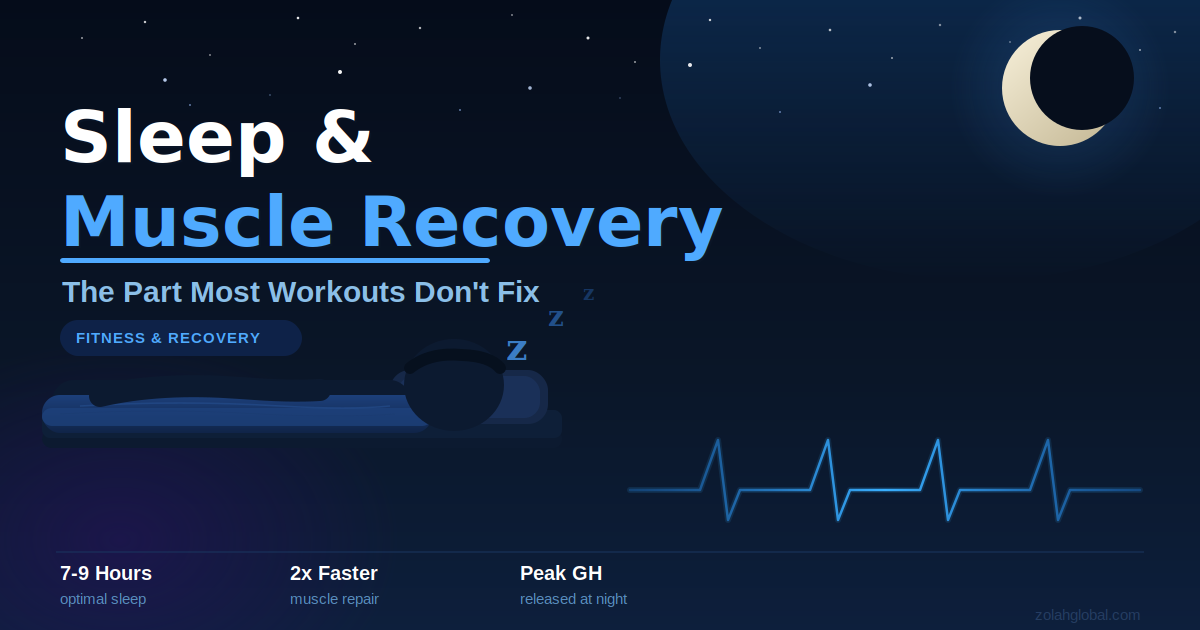
Sleep and muscle recovery are more closely linked than most people training today ever realise — and that gap in understanding may be the single biggest reason consistent effort isn’t producing consistent results.
If you’re training hard but still waking up sore, stiff, and exhausted — your workouts are probably not the problem. Your overnight recovery is. Most muscle repair doesn’t happen under the weights. It happens in the dark, in deep sleep, when your body finally gets the uninterrupted time it needs to rebuild what training broke down.
Miss quality sleep, and your muscles stay locked in “damage mode” — never completing the repair cycle, never fully rebuilding stronger. That’s why two people can do the exact same workout, eat the same food, and follow the same programme — yet one feels fresh and powerful 48 hours later while the other feels wrecked for days. The difference, more often than not, is what happens after the gym closes.
Training Hard But Still Sore, Weak, and Slow to Recover?
If your performance has plateaued and your body feels like it’s constantly playing catch-up — the problem almost certainly isn’t your training programme. It’s what your body has available to rebuild with while you sleep.
Your muscles rebuild using amino acids — the raw material for muscle protein synthesis. When those building blocks are available during sleep, recovery accelerates. When they’re not, the repair cycle stalls regardless of how many hours you spend in bed. Don’t let inadequate nutrition limit what good sleep can do for your recovery.
How Sleep and Muscle Recovery Work Together
Understanding the sleep and muscle recovery connection at the biological level changes how you approach both — and reveals why treating them separately produces inferior results.
1. Sleep Is When Muscle Repair Actually Happens
This is the foundation of everything: your muscles do not repair themselves during your workout. They repair themselves during recovery — and the most critical window of that recovery is deep sleep.
During slow-wave (deep) sleep, your pituitary gland releases growth hormone (GH) in its largest pulse of the entire 24-hour cycle. Growth hormone is the primary hormonal driver of muscle tissue repair — it stimulates protein synthesis, promotes fat metabolism for fuel, and directs the cellular machinery that rebuilds the micro-tears created by training into stronger, denser muscle fibres.
The relationship between sleep and muscle recovery begins here — and the maths is unforgiving: less deep sleep = less growth hormone = less repair = slower, weaker results. No amount of additional training compensates for this deficit. You cannot out-train a chronic sleep shortage.
The bottom line: If you’re not reaching deep sleep consistently — whether from short sleep duration, poor sleep quality, or irregular timing — your muscle repair is operating at a fraction of its biological capacity every single night.
2. Poor Sleep Keeps Inflammation Elevated
That heavy, tender, dragging feeling in your muscles the day after training? Most people attribute it entirely to workout intensity. In reality, a significant portion of that experience is driven by sleep quality — not training volume.
During sleep, your body regulates the inflammatory response that follows exercise. Pro-inflammatory cytokines — the signalling molecules that cause swelling and soreness — are actively downregulated during quality rest. Anti-inflammatory processes that clear metabolic waste from muscle tissue accelerate.
When sleep is cut short or disrupted, this regulation doesn’t complete. Systemic inflammation stays elevated. Soreness lingers longer. The heavy feeling persists into your next session. You begin training on tissue that hasn’t finished recovering — and the cycle compounds.
Improving sleep quality is one of the most direct, most underutilised interventions for reducing post-workout inflammation and accelerating the sleep and muscle recovery timeline.
3. Sleep Restores the Energy Your Muscles Need to Perform
Muscle recovery isn’t only about repairing damaged tissue. It’s also about restoring the energy substrate that powers your next performance — primarily muscle glycogen, the stored carbohydrate that fuels moderate-to-high intensity training.
Glycogen resynthesis — the process of refilling depleted muscle energy stores — is significantly enhanced during sleep. The hormonal environment of quality rest (lower cortisol, higher growth hormone and insulin-like growth factor-1) creates optimal conditions for this restoration. Poor sleep elevates cortisol, which is catabolic — it actively breaks down muscle glycogen and muscle protein rather than rebuilding them.
The result of chronic sleep deficiency in training individuals is predictable: workouts feel harder than they should. Strength feels lower. Endurance fades earlier. The gym starts feeling like a place where you go to confirm how tired you are — rather than where you go to get stronger.
This is the overlooked piece of the sleep and muscle recovery equation that explains why training feels inconsistent even when your programme hasn’t changed.
4. Sleep Deprivation Dramatically Slows Recovery Time
The research on this is direct and significant. Studies on sleep-deprived athletes consistently show:
- Muscle recovery time increases by 40–60% with chronic sleep restriction (5–6 hours vs 8+ hours)
- Protein synthesis rates decline measurably within 24 hours of insufficient sleep
- Perceived exertion during identical workouts increases — the same session feels significantly harder
- Injury risk rises as neuromuscular coordination degrades with accumulated sleep debt
If you are sleeping 4–5 hours per night, your muscles may be taking days longer to complete the recovery cycle than they would with adequate rest. The soreness isn’t a training problem. The plateau isn’t a programming problem. It is a sleep problem presenting as a fitness problem.
5. Prioritising Sleep Is the Most Underused Performance Upgrade Available
People who prioritise the connection between sleep and muscle recovery — treating overnight rest as seriously as they treat their training sessions — recover faster, perform more consistently, build strength more predictably, and stay injury-free longer.
It is not a coincidence that elite athletes across every sport treat sleep as one of their most protected performance assets. Roger Federer famously slept 10–12 hours per night during competition periods. LeBron James has spoken extensively about 8–10 hours as non-negotiable. These are not people with soft training demands — they are people who understand that performance is built in recovery, not in training alone.
The most underused performance enhancement available to most people is completely free. It requires no equipment. No programme. Just the decision to protect sleep as seriously as you protect your training.
Practical Steps to Improve Overnight Muscle Recovery
| Step | How It Supports Sleep and Muscle Recovery |
|---|---|
| Sleep 7–9 hours nightly | Maximises growth hormone release and full repair cycle completion |
| Keep a consistent sleep schedule | Regulates circadian rhythm so deep sleep stages are deeper and more restorative |
| Avoid screens 1 hour before bed | Reduces blue light suppression of melatonin — accelerates sleep onset |
| Eat protein before sleep | Provides amino acids for overnight muscle protein synthesis during the peak repair window |
| Cool, dark bedroom (65–68°F) | Promotes deeper slow-wave sleep stages where growth hormone release is highest |
| Limit alcohol post-workout | Alcohol directly disrupts REM and deep sleep — and suppresses protein synthesis for up to 24 hours |
| Support with amino acids | Ensures building blocks are available throughout the overnight repair window |

Protein Before Bed Is One of the Most Evidence-Backed Recovery Strategies Available
Research consistently shows that consuming protein — particularly casein or a complete amino acid profile — before sleep significantly increases overnight muscle protein synthesis rates. Your muscles have the hormonal environment to rebuild during sleep. Whether they have the raw materials to do so is determined by what you give them before you close your eyes.
Providing the essential amino acids your muscles need during the overnight repair window — so that quality sleep converts into maximum recovery, and every hour of rest produces the results your training effort has earned. This is what completes the sleep and muscle recovery equation.
The Bottom Line: Fix Your Sleep, Fix Your Recovery
If you’re stretching consistently, eating well, training smart — but still not recovering the way your effort deserves — the missing piece is almost certainly what’s happening (or not happening) while you sleep.
Muscles grow when you rest, not when you lift. The workout is the signal. Sleep is where the response happens. Every hour of quality rest is an hour your body is using to convert training stress into adaptation — into stronger, leaner, more resilient muscle.
Sometimes the real fitness upgrade isn’t a harder workout, a better programme, or a new supplement. It’s treating overnight recovery with the same intentionality you bring to everything else.
Sleep well. Feed your muscles before you do. And watch the results your training has always been capable of — finally start showing up.

Your Muscles Are Rebuilding Right Now — Make Sure They Have What They Need
Every night you sleep is a recovery window. Every morning you wake up is either evidence that window was used well — or that something was missing.
Join thousands of people who stopped treating recovery as passive rest and started giving their muscles the active nutritional support they need to rebuild faster, recover more completely, and perform better in every session that follows.
Disclaimer: This article is for informational purposes only and does not constitute medical or fitness advice. Consult a qualified healthcare or fitness professional before beginning any new supplement or making significant changes to your training or nutrition routine.
Disclosure: This post contains affiliate links. If you purchase through our link, we may earn a small commission at no extra cost to you. We only recommend products we believe deliver genuine value.