
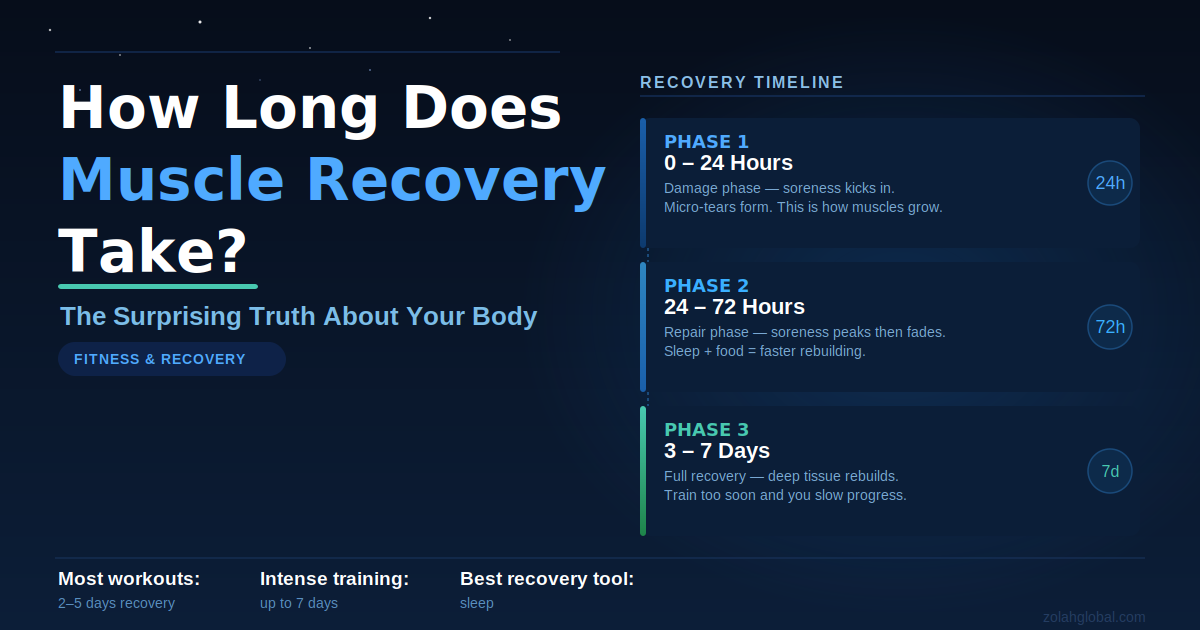
You wake up sore and stiff and asking yourself: how long does muscle recovery take — and is this soreness normal? Most people assume a day or two is enough. The truth is more surprising, and it explains why some people keep getting stronger while others feel tired and stuck despite training consistently.”
Most people assume muscle recovery takes a day or two. Rest up, eat something, and you’re back to full strength by tomorrow. The truth is more surprising — and it explains a pattern that separates people who keep getting stronger from those who train consistently but feel perpetually tired, stuck, and frustrated.
How long does muscle recovery take? The honest answer: longer than most people think, and far more dependent on what you do during recovery than most training programmes ever acknowledge.
Muscle recovery isn’t passive. It isn’t just resting on the couch waiting for soreness to fade. It is an active, multi-phase biological process happening inside your muscle tissue — and whether you support that process or inadvertently work against it determines whether your training produces results or just produces damage.
Here’s exactly what happens — and how to make every phase work for you.
Training Hard But Still Tired, Sore, and Not Getting Stronger?
Overtraining and under-recovering look identical from the outside. If your progress has stalled despite consistent effort — the problem is almost certainly in your recovery, not your training.
Formulated with the amino acids your muscle tissue needs to complete the repair and rebuilding process more efficiently — supporting faster recovery, reduced soreness, and stronger results from every training session. If you’re putting in the work, make sure your body has what it needs to convert that effort into actual progress.
What Actually Happens to Your Muscles After a Hard Workout
Before answering how long muscle recovery takes, it helps to understand what recovery actually is at the tissue level.
When you train hard — lifting weights, running, doing intense bodyweight work — you create microscopic damage in your muscle fibres. This sounds alarming, but it is entirely intentional and necessary. Those tiny tears, called micro-tears, are the stimulus your body responds to by rebuilding the tissue stronger and more capable than it was before.
This process is called muscle protein synthesis — your body breaking down damaged proteins and replacing them with new, stronger ones. It is how muscle is built. The workout is not where the gains happen. The workout is just the signal. The recovery is where the results are actually created.
This is why understanding how long muscle recovery takes is not a peripheral question for serious training. It is the central one.
The 3 Phases of Muscle Recovery
Muscle recovery happens in three distinct, sequential phases. Most people understand the first one. Almost nobody accounts for the third.
Phase 1: The First 24 Hours — The Damage Phase
This is when soreness begins. The micro-tears in your muscle fibres trigger an inflammatory response — your immune system floods the area with white blood cells and cytokines to begin the repair process. You may feel weak, tight, or tender to touch. The muscles may appear slightly swollen.
This is not injury. This is adaptation. Your body is already working to rebuild before you’ve even finished feeling sore.
What helps during this phase: adequate hydration (your lymphatic system needs fluid to clear the inflammatory byproducts), light movement to maintain circulation without adding new damage, and beginning your protein intake to give your body the amino acid raw materials it needs for repair.
What hurts during this phase: training the same muscle group again, alcohol (which directly impairs protein synthesis), and inadequate sleep (when the majority of growth hormone — your primary muscle repair hormone — is released).
Phase 2: 24–72 Hours — The Repair Phase
This is the phase most people are most familiar with — soreness peaks somewhere in this window, then begins fading. Your body is actively synthesising new muscle protein, rebuilding the damaged fibres, and laying down stronger tissue than existed before.
Delayed Onset Muscle Soreness (DOMS) — the specific soreness that peaks 24–48 hours after training rather than immediately — is the primary experience of this phase. It is caused not by lactic acid (a persistent myth) but by the inflammatory and repair processes occurring in the damaged tissue.
What determines how effectively your body completes this phase: protein quality and quantity (sufficient essential amino acids, particularly leucine, are required to trigger and sustain muscle protein synthesis), sleep quality (deep sleep stages release the growth hormone cascade that drives tissue repair), and light activity (increases blood flow, delivering nutrients to repairing tissue without disrupting the process).
This is the phase where nutritional support makes the most measurable difference to recovery speed and quality.
Phase 3: 3–7 Days — The Full Recovery Phase
This is the phase almost nobody accounts for — and the one that most directly determines long-term progress.
You may feel fine after 2–3 days. The soreness has faded. You feel ready to train again. But feeling recovered and being fully recovered are two different things.
During this extended phase, your muscles continue rebuilding deeper tissue structures, restoring glycogen (stored energy) to full capacity, completing connective tissue repair, and consolidating the neural adaptations that make the movement pattern more efficient. None of this is complete just because the surface soreness has gone.
Training the same muscle group heavily before this phase is complete — a pattern called cumulative fatigue — is one of the most common reasons consistent trainers plateau, get injured, or feel perpetually tired without clear cause. The muscle never gets the complete recovery window it needs to finish rebuilding stronger.
The timeline varies by intensity: light training may complete Phase 3 in 3 days. Heavy compound lifting (squats, deadlifts, bench press) may require the full 5–7 days for complete recovery in trained individuals.
What Speeds Up Muscle Recovery — And What Slows It Down
| Recovery Factor | Why It Helps |
|---|---|
| Sleep (most important) | Growth hormone releases during deep sleep to drive muscle fibre repair — this cannot be replicated any other way |
| Protein and sufficient calories | Amino acids provide the raw material for muscle protein synthesis — without adequate supply, rebuilding stalls |
| Hydration | Flushes metabolic waste products and transports nutrients to repairing tissue via the lymphatic and circulatory systems |
| Light movement on rest days | Increases blood flow to recovering tissue without adding new damage — active recovery outperforms complete rest |
| Adequate rest between sessions | Prevents training the same muscle before Phase 3 is complete — the most commonly violated recovery principle |

What slows recovery most: alcohol consumption (directly suppresses protein synthesis for up to 24 hours), chronic sleep deprivation (severely impairs growth hormone release), insufficient protein, training the same muscle group too soon, and chronic stress (elevated cortisol is catabolic — it breaks down muscle tissue rather than supporting its repair).
Signs Your Muscles Haven’t Finished Recovering
If you’re training consistently but experiencing these symptoms — the problem is almost certainly incomplete recovery, not lack of effort:
- Soreness that doesn’t improve after 5–7 days — your body is not completing the repair cycle
- Strength going down instead of up — cumulative fatigue is overriding adaptation
- Persistent fatigue even after adequate sleep — systemic recovery debt accumulating
- Mood changes or loss of training motivation — neurological signs of overreaching
- Increased injury frequency — connective tissue not receiving adequate repair time
- Performance declining despite consistent training — you are breaking down faster than you are rebuilding
These are not signs you need to train harder. They are signs your recovery process needs better support — nutritionally, structurally, or both.
Give Your Muscles the Building Blocks They Actually Need to Recover Faster
Phase 2 and Phase 3 of muscle recovery are driven by one thing above everything else: the availability of essential amino acids for muscle protein synthesis. Without adequate supply, the rebuild stalls — regardless of how well you sleep or how much you rest.
Provides your muscles with the specific essential amino acids required to complete protein synthesis efficiently — supporting faster progression through all three recovery phases so your training effort actually converts into strength and muscle. Stop leaving your recovery to chance.
So How Long Does Muscle Recovery Take — The Full Answer
The complete answer to how long muscle recovery takes:
- Light training (bodyweight, cardio): 24–48 hours for most people
- Moderate resistance training: 48–72 hours
- Heavy compound lifting: 72 hours to 7 days for full Phase 3 completion
- Completely new exercises or unaccustomed movements: up to 7–10 days
These timelines assume adequate sleep, sufficient protein, proper hydration, and appropriate rest between sessions. Without these inputs, recovery extends — sometimes indefinitely, creating the plateau and fatigue cycle that frustrates so many consistent trainers.
The people who keep getting stronger are not the ones who train the hardest. They are the ones who train smart enough to recover completely — and give their body everything it needs to finish the rebuild between sessions.
Recovery is not wasted time. It is the only time your training results are actually being created.
Final Thoughts: Recovery Is Where the Results Actually Live
Understanding how long muscle recovery takes changes how you approach training entirely. The workout is the stimulus. Sleep, nutrition, and recovery time are the response. Both are required. Neither works without the other.
Most people invest heavily in their training and almost nothing in their recovery — and then wonder why progress stalls, soreness lingers, and motivation fades. The fix is not training harder. It is recovering smarter.

Support Phase 1 with hydration and rest. Accelerate Phase 2 with protein and sleep. Respect Phase 3 by not returning too soon. And give your muscles the nutritional foundation they need to complete all three phases as efficiently as your biology allows.
Your results are built in recovery. Start treating it like the priority it is.
Train Hard. Recover Harder. See the Results You’ve Actually Earned.
You’re putting in the work. Make sure your body has everything it needs to convert that work into real strength and real muscle — not just accumulated fatigue.
Join thousands of people who stopped training through incomplete recovery — and started seeing the consistent progress that proper nutritional support makes possible. Your effort deserves results. This is how you make sure it gets them.
Disclaimer: This article is for informational purposes only and does not constitute medical or fitness advice. Consult a qualified healthcare or fitness professional before beginning any new supplement or training programme, especially if you have existing health conditions or injuries.
Disclosure: This post contains affiliate links. If you purchase through our link, we may earn a small commission at no extra cost to you. We only recommend products we believe deliver genuine value