You spent time perfecting your blowout hairstyles at home — every section, every pass of the brush. And for twenty minutes, it looked incredible. Then humidity hit, and it all unraveled.
You have done everything right. You washed your hair, dried it carefully, worked through it section by section with your round brush — and for about twenty glorious minutes, it looked incredible. Then humidity hit. Or you stepped outside. Or you simply slept on it, and by morning, all that work had completely unraveled.
If that sounds familiar, you are not alone. And more importantly, you are not doing it wrong. You are just missing a few pieces of information that most people never get — because nobody ever explains the why behind a blowout. They just tell you to blow-dry and hope for the best.
That changes today.
The Real Reason Blowouts Fall Flat
Here is something most hair tutorials skip entirely: your hair has a chemistry. Every strand is made up of keratin proteins held together by chemical bonds — and among the most important are hydrogen bonds. These bonds are what give your hair its natural shape, whether that is a tight coil, a loose wave, or pin-straight.
Here is the critical part. Hydrogen bonds break in the presence of water and heat. When you blow-dry your hair while applying tension with a brush, you are literally reshaping those bonds into a new configuration. When the hair cools and dries, the bonds reset — in the new shape you created.
That is the entire science of a blowout in two sentences.
So why does it not last? Because hydrogen bonds are temporary. The moment your hair encounters significant moisture — from humidity, rain, sweat, or even a steamy bathroom — those bonds soften again and your hair reverts toward its natural pattern. This is not a product failure or a technique failure. It is chemistry.
The good news? Once you understand it, you can work with it.

What Most People Get Wrong
The number one mistake people make with blowouts has nothing to do with their dryer or their brush. It is starting on hair that is too wet.
Soaking wet hair requires far more heat and time to dry, which means more cumulative thermal exposure — and more damage over time. Research published in the Journal of Cosmetic Science confirms that repeated high-heat styling without protective measures causes measurable structural damage to the hair’s cuticle and cortex. Porosity increases. Tensile strength drops. Breakage becomes more frequent.
The solution is simple: towel-blot your hair gently — no rubbing — and let it air dry to about 60–70% before you even pick up the dryer. This one change alone will improve your results and protect your hair long-term.
The second most common mistake is insufficient tension. A blowout is not just about heat. It is about heat and stretch working together. Your round brush needs to hold the hair taut throughout the drying process. Loose, floppy technique produces loose, floppy results — regardless of how expensive your tools are.
The Humidity Problem (And How to Actually Solve It)
If you live somewhere warm and humid — and plenty of us do — you already know that a blowout can collapse within hours of stepping outside. Here is why that happens, and what you can do about it.
When atmospheric moisture re-enters your hair shaft, it begins to re-break those hydrogen bonds, allowing your natural pattern to reassert itself. Anti-humidity products work by coating the cuticle with film-forming agents — typically silicones or polymers — that physically reduce how much moisture the hair can absorb.
The key is applying these products to damp hair before you blow-dry, not after. Once the style is set and cooled, a light finishing spray locks it further. This two-step approach — barrier before, sealant after — is how professional stylists keep blowouts looking fresh in the most challenging climates.
It Is Not Just for Straight Hair
One of the biggest myths about blowouts is that they only work on straight or wavy hair. That is simply not true.
Natural and textured hair — Types 3 and 4 — can achieve stunning blowout results. The technique is different, the products are heavier and more moisture-rich, and the process takes more time. But the transformation is extraordinary. A well-executed stretched blowout on Type 4 hair reveals length that shrinkage normally hides and creates a softness and versatility that is genuinely hard to achieve any other way.
The silk press — a blowout followed by a careful flat iron pass — has become one of the most requested styles in natural hair communities worldwide, and for good reason. Done correctly, with adequate heat protection and moisture restoration afterward, it is both beautiful and achievable at home.
Your Hair Is Worth Understanding
Here is the thing nobody tells you when you are standing in the bathroom at 7am trying to get your hair to cooperate: a great blowout is not a talent. It is a skill. And like every skill, it improves dramatically once you understand what you are actually doing and why.
The right heat range for your hair type. The correct brush diameter for the style you want. The products that genuinely protect versus the ones that just smell nice. The sectioning pattern that works for your density. The cool-air finish that sets everything in place. These are learnable things. Specific, concrete, actionable things.
And once you learn them, you have them for life.
Ready to Master Your Blowout for Good?
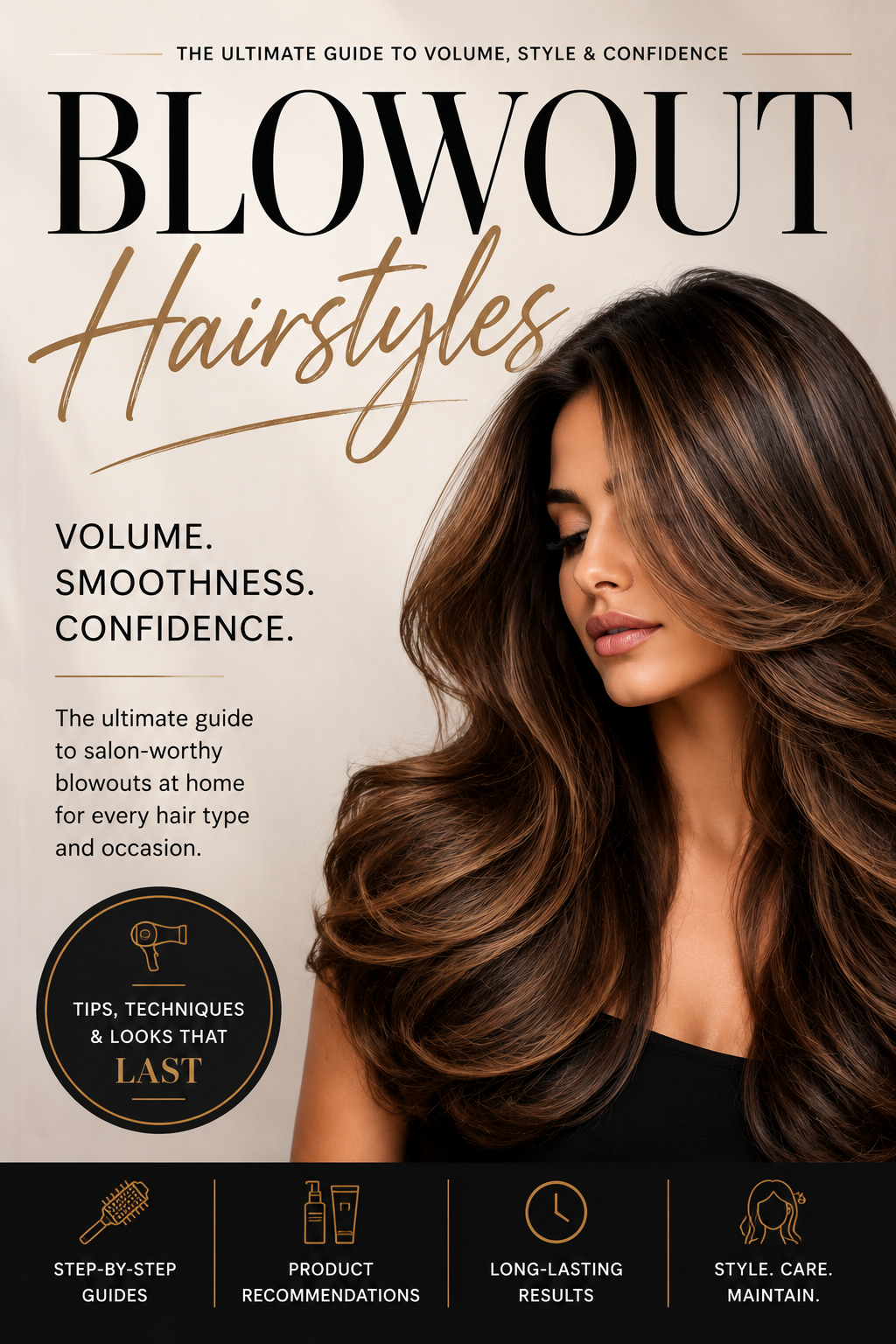
Blowout Hairstyles: The Complete Guide to Salon-Worthy Results at Home covers everything in this article — and goes much deeper. You will get the full science, the step-by-step techniques for every hair type, the toolkit breakdown, the product guidance, the longevity strategies, and the damage-prevention protocols that protect your hair between sessions. Blowout hairstyles at home work beautifully on natural and textured hair too…”
It is practical. It is detailed. It is written for real people with real hair and real schedules — not for a photoshoot.
Whether you have fine straight hair, thick resistant waves, tight natural coils, or anything in between, there is a chapter in this guide built specifically for you.
👉 Get your copy here and start your next wash day with the knowledge to back up every brushstroke.
This guide covers everything you need to achieve perfect blowout hairstyles at home…”
Because great hair was never luck. It was always information.