If your hair feels dry, brittle, thinning, or constantly breaking, a consistent natural hair repair routine could be the solution you’ve been missing…
You’ve tried the deep conditioners. The protein masks. The “miracle” oils everyone recommends. Maybe you’ve spent more money than you want to admit on products that promised transformation and delivered disappointment. The results felt good for a day or two, then your hair went right back to breaking, shedding, and feeling impossible to manage.
I lived that cycle for years. What finally changed everything wasn’t a new product. It was a consistent natural hair repair routine — combining the right external habits with something most women completely overlook: internal nourishment.
Here’s the exact 5-step routine that transformed my hair health — and why each step works on a biological level.
🌿 Still Dealing With Breakage, Shedding, or Thinning No Matter What You Try?
If external products alone haven’t been enough, there’s a reason — and this is it.
This isn’t another product recommendation. It’s a structured approach that targets hair damage from both the outside and inside — the only way to create results that actually last. Don’t let another season of breakage go by without doing something different.
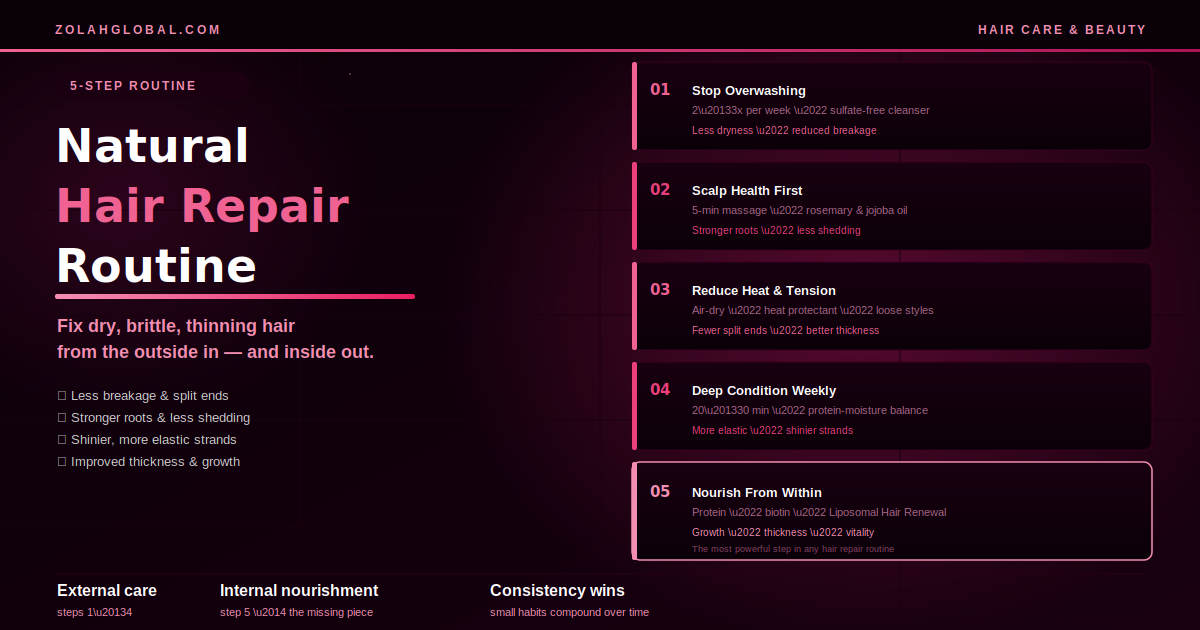
Step 1: Stop Overwashing Your Hair
Every effective natural hair repair routine starts here — and it’s the step most people never consider.
Your scalp produces sebum — a natural oil that travels down each strand, coating and protecting it from environmental damage, friction, and moisture loss. When you wash your hair every day (or even every other day), you strip that oil before it can do its job. Your scalp then overproduces oil to compensate, your hair cycles between greasy and bone-dry, and the cycle of damage continues.
When I reduced washing to 2–3 times per week and switched entirely to sulfate-free cleansers, the shift was noticeable within the first two weeks. Less dryness. Reduced breakage. Softer texture. Hair that actually felt like it had some life in it again.
Sulfates — the foaming agents in most conventional shampoos — are highly effective at removing oil, which sounds good until you realise they can’t distinguish between the oils that are damaging your hair and the oils that are protecting it. Sulfate-free cleansers clean without stripping, and your scalp finds its natural balance quickly.
Pro tip: A quality dry shampoo between wash days lets you extend your wash cycle without sacrificing cleanliness or feeling like you have to choose between product build-up and damage. Apply at the roots only and brush through gently.
Step 2: Prioritise Scalp Health Above Everything Else
Most women spend 90% of their hair care budget on products that never touch the scalp — and then wonder why their hair isn’t growing or recovering the way it should.
Healthy hair is built at the root. Every strand that grows from your scalp is only as strong as the follicle environment it came from. If your scalp is inflamed, product-clogged, poorly circulated, or nutrient-starved — the hair it produces reflects that, regardless of what you apply to the lengths.
What I added to my routine: 5 minutes of gentle daily scalp massage, rosemary and jojoba oil applied to the scalp 2–3 times per week, and a deliberate break from heavy styling products that cause build-up and block follicles.
The science behind scalp massage is solid — it increases blood circulation to hair follicles, directly improving the delivery of oxygen and nutrients to the cells responsible for growth. Rosemary oil has been shown in published clinical research to perform comparably to minoxidil for follicle stimulation, with significantly fewer side effects.
Within three weeks of adding this step: hair felt stronger at the base, shedding during washing reduced noticeably, and new growth became visible at the hairline.
Pro tip: Rosemary oil diluted in jojoba (5–6 drops per tablespoon of carrier oil) applied directly to the scalp 2–3 times per week is one of the most evidence-backed steps in any natural hair repair routine. The key is consistency over months, not days.
Step 3: Remove What’s Causing the Damage
Sometimes repair isn’t about adding more. It’s about eliminating what’s breaking your hair in the first place.
Flat irons, curling wands, and tight hairstyles are silent, cumulative destroyers of hair health. High heat (above 300°F) breaks down the disulfide bonds that give your hair its structural integrity — and once those bonds are damaged, no conditioner fully restores them. Tight ponytails and braids create constant tension on the follicle, leading to traction alopecia — a form of hair loss that starts gradually and becomes permanent if ignored.
The changes I made: air-drying whenever possible, using a heat protectant spray whenever I did apply heat, switching to loose protective styles with no scalp tension, and replacing my regular bath towel with a microfiber towel for drying.
That last one surprised me. Regular towel fibres create significant friction against wet, vulnerable hair — causing breakage and frizz before you’ve even styled. Microfiber towels absorb moisture gently, dramatically reducing that mechanical damage.
Pro tip: Microfiber towel drying instead of a regular towel is one of the simplest and most underrated switches in a natural hair repair routine. Scrunch gently — don’t rub. Your wet hair is at its most elastic and fragile state.
Step 4: Deep Conditioning — The Core of Your Natural Hair Repair Routine
One deep treatment will not fix damaged hair. This is where most women’s routines break down — they deep condition after a crisis and then stop when things seem better. But hair repair is a process of consistent rebuilding, not a one-time rescue.
Deep conditioning works by temporarily filling gaps in the hair’s cuticle layer, restoring elasticity, adding slip, and reducing the micro-fractures that lead to breakage. A protein-moisture balanced deep conditioner applied once a week for 20–30 minutes creates cumulative improvement — each session rebuilding a little more than the last.
Think of deep conditioning like strength training. One session at the gym doesn’t build muscle. But 12 consistent weeks does. The same principle applies to your hair.
What I added: a shower cap over my deep conditioner to trap natural heat from my scalp, which drives the ingredients deeper into the hair shaft for better absorption. The difference in results between a basic rinse-off and a properly applied, heat-activated deep treatment is significant.
Pro tip: Warm heat is your deep conditioner’s best friend. A warm towel or shower cap traps your natural body heat and opens the cuticle layer, allowing the conditioning ingredients to penetrate the cortex instead of just sitting on the surface. Do this every single week without fail.
Step 5: Nourish Your Hair From the Inside Out
This is the step that made everything else work — and the one most hair care articles never mention.
Your hair is made almost entirely of keratin — a structural protein — and your body requires a continuous supply of amino acids, vitamins, and minerals to produce it. When your diet is deficient in protein, iron, zinc, biotin, or collagen precursors, your body redirects available nutrients away from hair (non-essential) toward vital organs. The result: slow growth, increased shedding, thinner strands, and hair that breaks faster than it grows.
External products treat the hair you already have. Internal nutrition is what determines the quality of the hair you’re growing right now.
What I added: more protein at every meal, iron and zinc-rich foods (red meat, leafy greens, pumpkin seeds), consistent hydration, and targeted supplementation. When I added Liposomal Hair Renewal — a supplement specifically formulated with liposomal delivery technology for dramatically enhanced absorption — the shift over the following 6–8 weeks was unlike anything I’d experienced from topical products alone.
Liposomal delivery wraps nutrients in a lipid layer that bypasses the digestive breakdown most supplements face, delivering bioavailable nutrients directly to the cells that need them. More absorption means more actual impact on follicle function, strand strength, and growth rate.
Pro tip: Standard biotin supplements have a significant absorption limitation — most of what you take passes through unused. Liposomal delivery technology solves that problem, ensuring the nutrients that support hair repair actually reach the follicle. This single change was the turning point in my repair journey.

💊 Ready to Add the Internal Piece That Makes Every Other Step Work Harder?
You can follow the best external routine in the world — but if your body doesn’t have the raw materials to build strong hair, the results will always be limited.
🔴 👉 Try Liposomal Hair Renewal — The Internal Hair Support System With Superior Absorption Technology
Formulated specifically to support hair strength, thickness, reduced shedding, and healthy growth cycles — with liposomal delivery that ensures your body actually uses what you give it. Pair it with this 5-step routine for the complete inside-out transformation your hair has been waiting for.
Your Natural Hair Repair Routine: 5-Step Summary
| # | Step | Result | Start Today |
|---|---|---|---|
| 1 | Stop overwashing | Less dryness and breakage | Switch to 2–3x/week + sulfate-free |
| 2 | Scalp health first | Stronger roots, less shedding | 5-min massage + rosemary oil |
| 3 | Reduce heat and tension | Fewer split ends, better thickness | Air-dry + heat protectant + microfiber |
| 4 | Deep condition weekly | More elastic, shinier strands | 20–30 min treatment every week |
| 5 | Internal nourishment | Growth, thickness and vitality | Protein + biotin + Liposomal support |
Does a Natural Hair Repair Routine Actually Work?
Yes — when it addresses both external care and internal nourishment simultaneously.
That’s the combination most routines miss. Topical products manage the hair you already have. Internal nutrition builds the hair you’re growing. When you do both consistently — for months, not days — the transformation compounds into results that are genuinely visible and lasting.
Your hair can recover. Follicles that have been stressed, depleted, or neglected are not permanently damaged in most cases. They’re waiting for the right environment. This routine creates that environment.
Final Thoughts: Build Your Natural Hair Repair Routine Today
The best natural hair repair routine is the one you actually commit to — consistently, patiently, and completely. Not a 2-week experiment. Not a monthly deep condition when you remember. A real, daily and weekly practice that gives your hair everything it needs to rebuild.
Start with one step from this list today. Add another next week. Build the system slowly so it becomes effortless — and then protect it.
Your hair has the ability to transform. It just needs the right conditions and the time to show you.
🌱 Give Your Hair Everything It Needs — Inside and Out
You now have the complete external routine. The only piece left is making sure your body has the internal fuel to make it work at full power.
🔴 👉 Start Liposomal Hair Renewal Today — Click Here Before Stock Runs Out
Join thousands of women who stopped settling for temporary results — and finally rebuilt their hair from the root up. Stronger. Thicker. Healthier. Starting from the inside out.
⚠️ Disclaimer: This article reflects personal experience and is for informational purposes only. Individual results vary. Consult a qualified healthcare professional before beginning any new supplement, especially if you have an existing medical condition.
Disclosure: This post contains affiliate links. If you purchase through our link, we may earn a small commission at no extra cost to you. We only recommend products we believe deliver genuine value.