If you’ve been asking yourself “why is my hair not growing?” — you’re not alone, and you’re not imagining it.
You do everything you’re supposed to. You moisturise. You deep condition. You protective style. You avoid heat. And yet your hair stays stubbornly at the same length, month after month, while everyone around you seems to be retaining inches effortlessly. The frustration is real. The confusion is real.
Here’s what most hair care content won’t tell you: slow or stalled hair growth is almost never caused by one thing. It’s a combination of hidden factors — nutritional gaps, hormonal shifts, scalp conditions, daily habits, and internal deficiencies — all quietly working against your hair’s potential simultaneously.
The good news: every single cause on this list is addressable. You don’t have to accept stalled growth as your normal. You just need to know what’s actually causing it — and target each one directly.
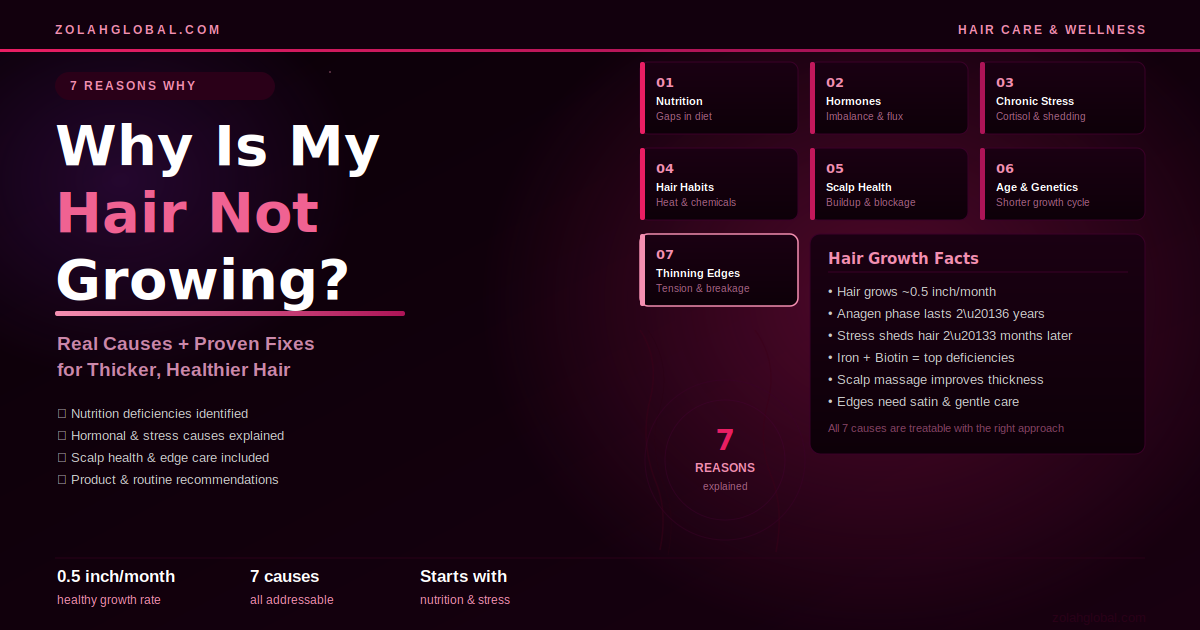
Here are the 7 most common reasons your hair isn’t growing, and exactly what to do about each one.
Tired of Your Hair Refusing to Grow No Matter What You Try?
If you’ve been doing everything right externally but still not seeing growth — the problem is almost certainly internal. And topical products can’t fix an internal deficiency.
Formulated with superior liposomal absorption technology to deliver hair-critical nutrients directly to the follicle — not just past your digestive system and out. This is the internal support layer that makes every external habit work harder. Don’t let another 6 months pass wondering why your hair won’t grow.
Reason 1: Hidden Nutritional Deficiencies
This is the most common — and most overlooked — answer to “why is my hair not growing?”
Your hair follicles are among the most metabolically active cells in your body. They require a constant, high-quality supply of specific nutrients to complete the growth cycle. When even one key nutrient is deficient, the follicle slows production, shortens the growth phase, and in severe cases, shuts down entirely.
The most impactful deficiencies for hair growth: iron (one of the most common in women, particularly those with heavy periods — iron-deficiency anaemia is a leading cause of female hair loss), biotin (essential for keratin synthesis — the protein hair is literally made of), Vitamin D (receptor deficiency directly linked to hair loss conditions), zinc (regulates the growth and repair phase of follicles), and Vitamin B12 (essential for red blood cell production, which carries oxygen to follicles).
The critical mistake most people make: buying random supplements without knowing which deficiencies they actually have. Targeted supplementation based on actual bloodwork produces dramatically better results than guessing.
Pro tip: Get a blood panel before buying supplements. Ask specifically for ferritin (stored iron — not just haemoglobin), Vitamin D, B12, zinc, and thyroid markers. The results will tell you exactly where to focus your investment. Guessing wastes money and time.
Reason 2: Hormonal Imbalances
Hormones are the master regulators of your hair growth cycle — and disruptions you may not even be aware of can halt growth almost overnight.
Thyroid hormones directly control the rate at which follicles cycle through growth, rest, and shedding phases. Both hypothyroidism and hyperthyroidism cause hair thinning and loss. Estrogen and progesterone extend the growth (anagen) phase — which is why many women experience their best hair growth during pregnancy. Their postpartum drop is why the months after delivery often bring dramatic shedding.
DHT (dihydrotestosterone) — the androgen responsible for pattern hair loss — binds to follicle receptors and progressively miniaturises them. High-stress lifestyles, certain birth control changes, and hormonal transitions like perimenopause all affect the delicate hormonal balance your follicles depend on.
If you’re experiencing sudden increased shedding, progressive thinning at the part line, or hair that seems to stop growing and start breaking — a hormonal investigation is essential before assuming it’s a product or routine problem.
Pro tip: Ask your doctor for a TSH, Free T3/T4, full hormone panel including DHEAS and testosterone, and ferritin levels. Many women spend years — and hundreds of pounds on products — when a single blood test would have identified a correctable hormonal imbalance as the root cause.
Reason 3: Chronic Stress Is Silently Destroying Your Follicles
Stress doesn’t just make you feel worse. It physically disrupts your hair growth cycle at the follicular level.
Telogen effluvium is the clinical term for stress-induced hair shedding — a condition where elevated cortisol signals hair follicles to prematurely exit the growth phase (anagen) and enter the resting phase (telogen) en masse. The result is dramatic, diffuse shedding — typically appearing 2–3 months after the triggering stressful event, which is why most people don’t connect the cause and effect.
The follicles themselves are not permanently damaged in most cases. But while they sit in the resting phase, they’re not growing. And chronic, sustained stress — the low-level ongoing pressure of modern life — can keep follicles in this suppressed state indefinitely.
Managing cortisol is not a luxury wellness habit. It is a biological requirement for normal hair growth. Meditation, yoga, consistent sleep, deep breathing practices, and adaptogenic herbs (ashwagandha, rhodiola) have all demonstrated measurable cortisol-reducing effects in clinical research.
Pro tip: The 2–3 month delay between stressful event and visible shedding means most people are treating the wrong problem at the wrong time. If you’re shedding heavily right now, ask yourself what was happening in your life 2–3 months ago — that is likely the trigger. Address the stress, and the follicles will recover.
Reason 4: Your Daily Hair Habits Are Quietly Causing Breakage
Sometimes the answer to “why is my hair not growing?” isn’t that it isn’t growing — it’s that it’s breaking at the same rate it grows, creating the illusion of no progress.
Heat styling without a protectant creates micro-fractures along the hair shaft that lead to progressive breakage. Over-processing with chemical relaxers, dyes, and bleach degrades the disulfide bonds that give hair its structural integrity. Tight protective styles — worn too long or with too much tension at the root — cause traction alopecia, a form of follicular damage that begins as temporary and becomes permanent if not addressed.
The habits that protect length retention: sulfate-free cleansing (preserves the moisture and natural oils that keep hair flexible), ammonia-free colour where possible, heat protectant every single time heat is applied, and protective styles with zero scalp tension — if it feels tight, it’s causing damage.
Pro tip: Quality of care beats frequency every time. Two gentle wash days per week done correctly produces better results than five rushed, aggressive sessions. Your hair doesn’t need more attention — it needs better attention.
Reason 5: Scalp Health Issues Nobody Talks About
You cannot grow healthy hair from an unhealthy scalp. This is the conversation most hair care content skips entirely — and it may be the most important one.
Your scalp is the soil your hair grows from. When that soil is compromised — by chronic dandruff, scalp psoriasis, seborrhoeic dermatitis, folliculitis, or simple product build-up — follicles are literally blocked, inflamed, or starved of the circulation they need to produce strong growth.
Product build-up alone — dry shampoo residue, heavy stylers, hard water mineral deposits — creates a layer over the scalp that impairs sebum movement, reduces follicular oxygenation, and creates the warm, humid environment where fungi thrive and dandruff worsens.
A three-step scalp protocol produces transformative results: gentle exfoliation once weekly to clear build-up (a scalp scrub or diluted apple cider vinegar rinse), an antioxidant scalp serum applied to the scalp between wash days, and 5 minutes of daily scalp massage — which has been shown in clinical research to measurably increase hair thickness over time by improving dermal papilla cell activity.
Pro tip: Scalp massage done consistently for 24 weeks has been shown in published research to produce statistically significant increases in hair thickness. The mechanism is direct — mechanical stimulation increases blood flow to dermal papilla cells (the cells that drive follicle activity). Five minutes daily, every day, is more effective than longer occasional sessions.

Reason 6: Aging and Genetics — Working With What You Have
As we age, the anagen (active growth) phase of the hair cycle progressively shortens while the telogen (resting) phase extends. The result: each hair grows for less time before shedding, producing shorter maximum lengths, finer strands, and lower overall density. Hormonal decline — particularly oestrogen in women after perimenopause — accelerates this process.
Genetics determine your baseline susceptibility. If your mother or maternal grandmother experienced thinning or shorter maximum lengths, your follicles likely carry similar predispositions.
But genetics is not destiny. You cannot change your genetic code — but you can optimise the environment your follicles operate in. Low-Level Laser Therapy (LLLT) has robust clinical evidence for extending the anagen phase and reactivating dormant follicles. PRP (Platelet-Rich Plasma) treatments stimulate growth factors directly at the follicle level. Targeted supplementation — particularly biotin, collagen peptides, and keratin support — helps maintain growth quality despite declining hormonal support.
Pro tip: If hair thinning runs in your family, start preventive support before the thinning becomes obvious — not after. Early intervention is significantly more effective than trying to reverse established miniaturisation. Know your history and act on it early.
Reason 7: Thinning Edges — The Most Visible Answer to “Why Is My Hair Not Growing?”
For many women, the most distressing visible sign of stalled growth is thinning edges — the progressive recession of the hairline at the temples and perimeter.
The causes are almost always the same: traction from tight styles (braids, weaves, buns, and ponytails that pull at the follicles repeatedly over time), harsh chemical exposure at the hairline, over-manipulation, and sleeping without protective coverage (cotton pillowcases create significant friction against vulnerable edge hair every single night).
Edges require a specific, gentler approach than the rest of your hair. They are finer, more fragile, and more susceptible to permanent follicular damage if traction continues unchecked. The edge-specific protocol: gentle cleansing only, no heat or chemicals directly on the hairline, nightly satin bonnet or pillowcase, and dedicated edge treatments that support follicular recovery.
This is where targeted internal support makes its most visible difference. When follicles at the hairline are nutritionally supported from within — with the bioavailable nutrients they need to complete the growth cycle — regrowth at the edges becomes measurably faster and more sustainable than topical treatments alone.
Pro tip: Never sleep without a satin bonnet or satin pillowcase. Cotton fabric creates friction that abrades delicate edge hair with every movement during sleep — and since you move an average of 40 times per night, the cumulative damage over months is significant. This single change protects your edges every night automatically.
Ready to Address Your Hair Growth From the Inside — Where It Actually Starts?
Every reason on this list has an internal component. Deficiencies, hormones, stress, follicular health — all of them respond to what your body receives at the cellular level. Topical products treat the surface. Internal support rebuilds the foundation.
Standard supplements face significant absorption limitations — most of what you take passes through before reaching your follicles. Liposomal delivery wraps each nutrient in a lipid layer that bypasses digestive breakdown, delivering bioavailable support directly to the cells responsible for hair growth. Pair it with the 7 fixes in this guide and attack every cause simultaneously.
Quick Reference: 7 Reasons Your Hair Isn’t Growing
| # | Reason | Key Symptom | Quick Fix |
|---|---|---|---|
| 1 | Nutritional deficiencies | Brittle, slow-growing hair | Blood test + targeted supplements |
| 2 | Hormonal imbalances | Sudden shedding or thinning | Full hormone panel + diet support |
| 3 | Chronic stress | Excessive diffuse shedding | Cortisol management + adaptogens |
| 4 | Damaging hair habits | Breakage and dullness | Gentle routine + heat protection |
| 5 | Scalp health issues | Itching, flaking, slow growth | Scalp detox + daily massage |
| 6 | Aging and genetics | Thinner, shorter hair cycles | LLLT + biotin + keratin support |
| 7 | Thinning edges | Receding hairline at temples | Edge routine + internal treatment |
Bottom Line: Why Is My Hair Not Growing?
The answer is almost never just one thing.
Most people asking “why is my hair not growing?” are dealing with a combination of factors — nutritional gaps, hormonal disruption, chronic stress, rough handling, and compromised scalp health — all working against their follicles simultaneously. Each one reduces growth potential. Together, they can halt it entirely.
The empowering truth: every single reason on this list is addressable. None of them require expensive professional treatments to start. Most of them start with what you eat, how you manage stress, how gently you handle your hair, and what you give your body internally to support follicular function.
Start with the causes that resonate most with your situation. Address them consistently over 90 days. Then assess. Your hair’s potential has not disappeared — it’s waiting for the right conditions to express itself.
Give Your Follicles What They’ve Been Missing — Starting Today
You now know every reason your hair may not be growing — and exactly what to do about each one. The final piece is making sure your body has the internal nutritional support to act on everything you’ve just learned.
👉 Start the Liposomal Hair Renewal Treatment Today — Click Here Before Stock Runs Out
Join thousands of women who stopped guessing at the surface and started rebuilding from the root. Thicker. Longer. Stronger. Starting from the inside out — starting today.
Why Is My Hair Not Growing? The Answer Is Rarely Just One Thing
Disclaimer: This article is for informational purposes only and does not constitute medical advice. If you are experiencing significant hair loss, please consult a qualified dermatologist or healthcare professional for diagnosis and treatment.
Disclosure: This post contains affiliate links. If you purchase through our link, we may earn a small commission at no extra cost to you. We only recommend products we believe deliver genuine value.