Have you ever felt like your mind is wrapped in cotton? If you’re searching for how to get rid of brain fog, you’re not alone…
You sit down to work and the thoughts won’t connect. You walk into a room and forget why you’re there. Someone asks you a simple question and you pause longer than you should. Simple tasks feel exhausting. Conversations require more effort than they used to. The sharpness you remember having — that feeling of being on — seems like it belongs to a different version of you.
If you’re searching for how to get rid of brain fog, you are not alone. Millions of people live with this daily — and most of them assume it’s just stress, aging, or “how they are now.”
It’s not. Brain fog isn’t a personality trait or an inevitable decline. It’s feedback. Your brain is signalling that it’s overloaded, under-rested, or missing the essential inputs it needs to function clearly. Address those inputs — consistently — and the fog lifts.
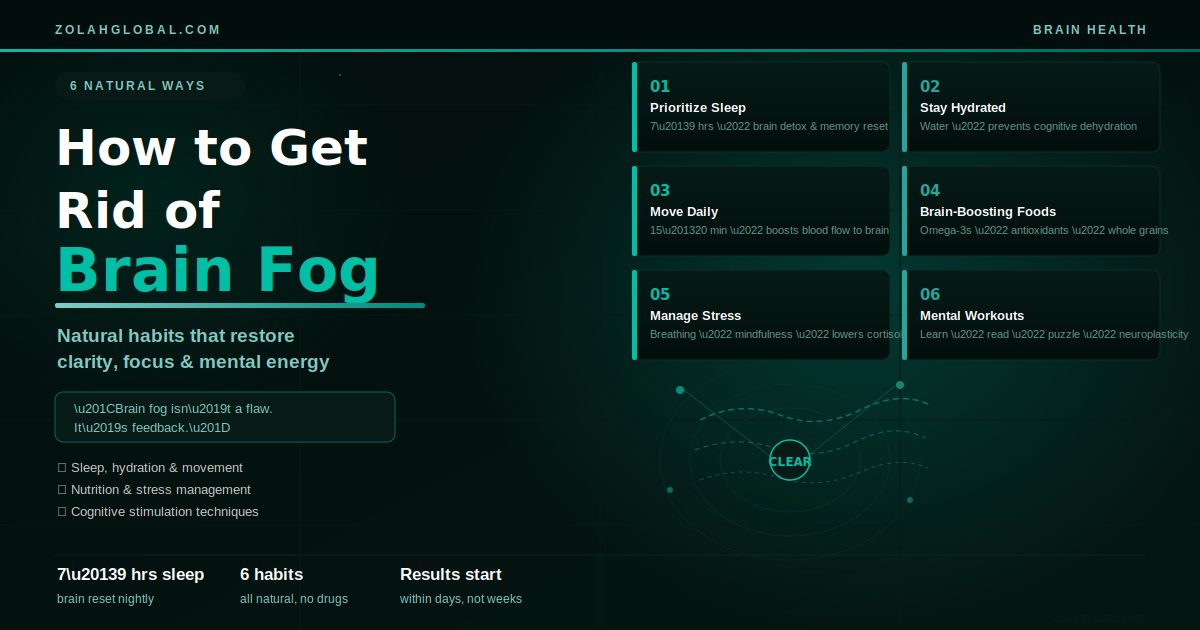
Here are 6 natural, evidence-backed ways to do exactly that.
🧠 Still Struggling With Brain Fog Even After Trying the Basics?
If sleep, water, and diet improvements haven’t been enough to fully clear the mental haze — your brain may need targeted nutritional support that lifestyle changes alone can’t provide.
NeuroActiv6 is a science-formulated blend of vitamins, minerals, and clinically studied herbal ingredients designed to nourish your brain at the cellular level — complementing every habit in this guide for compounded cognitive clarity. Don’t accept brain fog as your baseline. Your sharpest thinking is still available to you.
1. Prioritise Sleep — Your Brain’s Nightly Reset
Sleep is not passive rest. It is the most cognitively productive period of your entire 24-hour cycle — and skipping or shortening it is one of the fastest, most reliable ways to generate brain fog.
During sleep, your brain activates the glymphatic system — a waste-clearance network that flushes out metabolic byproducts, including amyloid beta (linked to cognitive decline) and other neurological waste products that accumulate during waking hours. When you sleep less than your brain needs, this clearance is incomplete. You wake up with a cognitive backlog — sluggish processing, impaired working memory, reduced ability to concentrate — that compounds with each night of insufficient sleep.
The target: 7–9 hours of quality sleep, with consistent timing. Your brain runs on a circadian clock, and going to bed and waking at the same time daily is more important than total sleep hours for cognitive function. Variability in sleep timing —sleeping late on weekends, staying up late on weeknights — disrupts the clock in ways that impair performance all week.
Create a 30-minute wind-down routine: dim your lights, stop screens 60 minutes before bed, and replace scrolling with something calm — journaling, light stretching, or reading.
Practical tip: Consistent sleep timing is the single most impactful sleep change you can make. Your brain’s internal clock regulates not just sleepiness but memory consolidation, cortisol rhythms, and neurotransmitter production. Protecting that clock protects your cognitive clarity every day.
2. Hydrate Your Brain — More Than You Think You Need To
Your brain is approximately 75% water. Even mild dehydration — as little as 1–2% loss of body water — measurably impairs focus, working memory, reaction time, and mood. You don’t have to be visibly thirsty to be cognitively impaired by dehydration. By the time thirst signals arrive, the impairment is already happening.
Water is the medium in which every chemical reaction in your brain occurs — neurotransmitter synthesis, ion channel function, electrical signal transmission. When the medium is depleted, the reactions slow. Thinking becomes effortful. Memory retrieval lags. The cotton-wool sensation intensifies.
The fix is simple but requires intentionality: start every morning with a full glass of water before coffee, before food, before checking your phone. Carry a water bottle throughout the day. Watch for dehydration signals — headaches, afternoon fatigue, difficulty concentrating, dry skin — and treat them as brain signals, not inconveniences.
Practical tip: Drinking water immediately upon waking and before each meal are the two highest-impact hydration habits for sustained brain clarity. These two moments alone can meaningfully increase your daily water intake without requiring constant reminders throughout the day.
3. Move Your Body to Awaken Your Mind
Exercise is one of the most powerful, most immediate interventions available for brain fog — and you don’t need an hour at the gym to feel it.
Physical movement increases cerebral blood flow, delivering oxygen and glucose directly to the neurons responsible for focus, working memory, and executive function. It stimulates the release of BDNF (Brain-Derived Neurotrophic Factor) — often called “Miracle-Gro for the brain” — a protein that promotes neuroplasticity, supports new neural connection formation, and protects existing neurons from degeneration.
Most people notice their mental clarity improves almost immediately after movement. The fog that felt immovable at 2 p.m. often clears significantly after a 15-minute walk. That’s not coincidence — it’s blood flow, BDNF, and a shift in neurochemistry that exercise reliably triggers.
You don’t need intensity. You need consistency. 15–20 minutes of brisk walking, yoga, or bodyweight movement daily is enough to produce measurable cognitive benefit when done regularly.
Practical tip: A 10-minute walk outside is one of the highest-ROI brain fog interventions available. It combines movement (BDNF and blood flow), natural sunlight (circadian regulation and serotonin), and fresh air (CO2 clearance) — three simultaneous brain benefits from a single 10-minute habit.
4. Feed Your Brain the Nutrients It Actually Needs
Your brain is the most metabolically expensive organ in your body — consuming approximately 20% of your total energy intake despite being only 2% of your body weight. It runs on a constant, high-quality supply of specific nutrients. When those nutrients are absent or depleted, cognitive performance degrades visibly and quickly.
The key nutrients for brain clarity: omega-3 fatty acids (DHA specifically, the primary structural fat in brain cell membranes), antioxidants (protecting neurons from oxidative stress), B vitamins (essential for neurotransmitter synthesis and energy metabolism), and magnesium (involved in over 300 biochemical reactions, including those governing neural transmission).
Foods that deliver these consistently: leafy greens, blueberries and other berries, walnuts, fatty fish (salmon, sardines, mackerel), eggs, and whole grains. Avoid excessive sugar and processed foods — they spike blood glucose rapidly, causing the energy crash and attention impairment that follow every carbohydrate spike.
Practical tip: Blueberries and walnuts are two of the most extensively studied foods for cognitive clarity — both are easy to add to breakfast without any extra preparation. A small handful of walnuts and a cup of blueberries added to your morning routine provides meaningful omega-3, antioxidant, and polyphenol support for daily brain function.
5. Manage Stress Before It Manages Your Mind
Chronic stress is one of the most direct, most physiologically damaging causes of persistent brain fog — and it operates through a mechanism most people never address.
Sustained elevated cortisol — the primary stress hormone — physically shrinks the hippocampus, the brain region responsible for memory formation, learning, and spatial navigation. It impairs prefrontal cortex function, degrading decision-making, focus, and impulse control. It disrupts sleep quality, which compounds cognitive impairment. And it creates a neuroinflammatory state that slows processing speed throughout the brain.
You cannot think your way to clarity while your stress system is chronically activated. You have to physiologically interrupt it.
The most effective accessible interventions: box breathing (4 counts in, hold 4, out 4, hold 4) directly activates the vagus nerve and parasympathetic nervous system within minutes. Two 5-minute “reset breaks” daily — eyes closed, deep breathing, deliberate tension release — measurably reduce cortisol accumulation and restore cognitive clarity.
Practical tip: Box breathing is one of the fastest and most evidence-supported ways to lower cortisol and restore focus acutely. Four full cycles takes under 90 seconds. Use it at the first sign of mental overwhelm — before the fog has a chance to fully settle.
6. Challenge Your Brain With Gentle Mental Workouts
Your brain follows the same adaptive principle as your muscles: use it and it strengthens; leave it unstimulated and connections weaken.
Cognitive stimulation — particularly novelty-driven learning — strengthens neural pathways, improves processing speed, and builds what neuroscientists call cognitive reserve: the accumulated neural resilience that protects against decline and supports sharp thinking throughout life.
The key is novelty. Your brain benefits most from activities that are new and moderately challenging — not routine tasks it can process on autopilot. Learning a new language activates entirely different neural networks than your usual scroll through social media. Reading a challenging article builds different connections than watching passive video content.
Dedicate 15–30 minutes daily to genuine cognitive engagement: a language app, a complex article in an unfamiliar field, a strategy game, a challenging puzzle, or a new skill you’re genuinely curious about.
Practical tip: The novelty principle is what makes this habit work — your brain releases dopamine in response to new learning, which itself improves motivation, attention, and cognitive performance. The subject matters less than the newness. Pick something you’re genuinely curious about and the engagement takes care of itself.
How to Get Rid of Brain Fog: Quick Reference
#
Habit
Why It Works
Quick Action
1
Sleep 7–9 hours
Brain detox and memory reset via glymphatic system
Set a fixed bedtime — same time every night
2
Drink more water
Even 1–2% dehydration impairs cognition
Full glass of water first thing every morning
3
Move daily
Boosts BDNF and blood flow to brain
15-min walk after lunch — outside if possible
4
Eat brain foods
Provides omega-3s, antioxidants, B vitamins
Add blueberries and walnuts to breakfast
5
Manage stress
Lowers cortisol that shrinks hippocampus
2 × 5-min box breathing breaks daily
6
Mental stimulation
Consistent cognitive challenge is the long-term habit that answers how to get rid of brain fog permanently — not just acutely.
15 min of genuine new learning daily
Want to Accelerate Your Results With Targeted Brain Nutrition?
These 6 habits create the foundation. But for many people — especially those dealing with prolonged brain fog, nutritional gaps, or the cognitive effects of chronic stress and aging — targeted supplementation provides the additional cellular-level support that diet and lifestyle alone can’t fully deliver.
Formulated with clinically studied ingredients that support BDNF production, reduce neuroinflammation, and nourish the neurotransmitter systems responsible for focus, memory, and mental clarity — NeuroActiv6 is the internal support layer that makes every habit in this guide work harder. Pair it with the 6 habits above and address brain fog from every angle simultaneously.
Does Getting Rid of Brain Fog Naturally Actually Work?
Yes — when you address the actual causes consistently, rather than masking the symptoms temporarily.
Brain fog is almost always the result of multiple compounding deficits: insufficient sleep, dehydration, poor nutrition, chronic stress, insufficient movement, and cognitive understimulation. Each one degrades clarity individually. Together, they create the persistent haze that makes thinking feel like wading through mud.
Address them simultaneously — even imperfectly — and the compound effect on cognitive clarity is dramatic. Most people notice meaningful improvement within the first 7–10 days of consistent implementation. Full restoration of sharp, clear, energised thinking typically follows within 3–4 weeks.
Your brain is not broken. It is deprived. Give it what it needs — and watch it respond.
Final Thoughts: Start Clearing the Fog Today
Knowing how to get rid of brain fog comes down to one principle: give your brain what it needs, consistently, and stop giving it what depletes it.
Start with the one that feels most immediately actionable. Add another the following week. The habits compound — and so does the clarity.
The sharpest version of your mind is not behind you. It’s waiting for the right conditions to re-emerge.
🧠 Take the First Step Toward a Clearer, Sharper Mind — Right Now
You have the habits. You understand the science. The only piece left is making sure your brain has the targeted nutritional fuel to make those habits work at full power.
Join thousands of people who stopped accepting brain fog, poor memory, and mental fatigue as their new normal — and gave their brain the support it was asking for. Clarity is closer than you think. Start today.
Disclaimer: This article is for informational purposes only and does not constitute medical advice. Consult a qualified healthcare professional before beginning any new supplement or making significant changes to your health routine, especially if you have existing medical conditions.
Disclosure: This post contains affiliate links. If you purchase through our link, we may earn a small commission at no extra cost to you. We only recommend products we believe deliver genuine value.
How to Lose Weight Without the Gym: 10 Proven Daily Habits That Actually Work
If you’re wondering how to lose weight without the gym, here’s the truth most fitness content won’t tell you upfront: sustainable fat loss happens mostly in your kitchen and through…