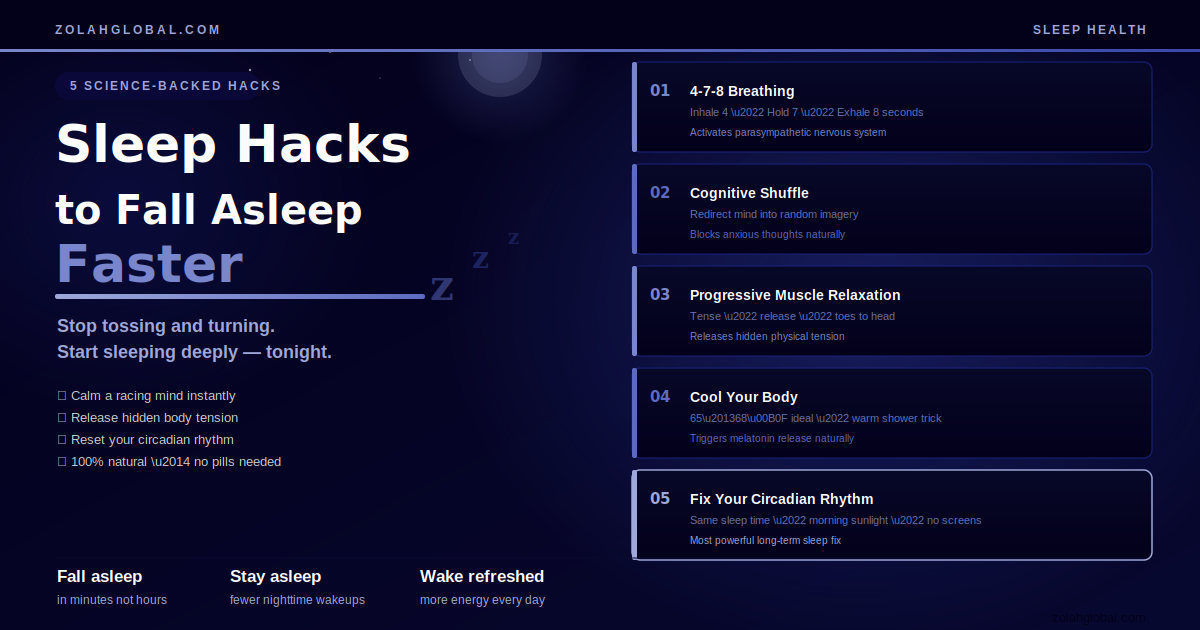
“…these sleep hacks to fall asleep faster are grounded in neuroscience… “These science-backed sleep hacks to fall asleep faster work with your neurobiology — not against it.”
Lying in bed completely exhausted — but wide awake. Mind running through tomorrow’s to-do list, replaying old conversations, catastrophising things that haven’t happened yet. You watch 10 minutes become 30. Then an hour. Then you start doing the maths: “If I fall asleep right now, I’ll get 5 hours and 20 minutes…”
You’re not broken. You’ve just never been taught how sleep actually works.
Science has uncovered simple, powerful techniques that calm your nervous system, quiet the mental noise, and send a clear signal to your brain that it’s safe to switch off. These aren’t wellness trends — they’re neuroscience. Here are the 5 most effective, research-backed sleep hacks available, and exactly how to use each one tonight.
Tired of Lying Awake Despite Being Exhausted Every Single Night?
One technique won’t fix what a system can. What most people need isn’t another tip — it’s a complete, structured nightly routine that chains these methods together in the right order.
Built around all 5 techniques in this article, the Sleep Hacking program gives you a clear nightly protocol — not scattered tips, but a sequenced system that works with your neurobiology. Tonight could be different. But only if you have the right structure.
Sleep Hack 1: The 4-7-8 Breathing Trick
If your biggest sleep problem is an overactive, anxious mind at bedtime — this technique is the fastest intervention available without medication.
The 4-7-8 breathing method directly activates your parasympathetic nervous system — the branch of your autonomic nervous system responsible for rest, digestion, and recovery. Most people live in a state of low-grade sympathetic activation (fight-or-flight) all day. When you lie down, that activation doesn’t automatically switch off — which is why your mind races the moment things go quiet.
How to do it: Inhale through your nose for 4 seconds. Hold for 7 seconds. Exhale completely through your mouth for 8 seconds. Repeat 4–8 cycles.
The extended exhale is the key mechanism. A longer exhale than inhale activates the vagus nerve, directly slowing your heart rate and triggering the physiological relaxation response. Anxiety cannot sustain itself in a parasympathetically dominant nervous system. Most people report feeling noticeably drowsy within 3–4 cycles.
Pro tip: Do this lying down in bed with your eyes closed and the room dark. The combination of physical position, darkness, and the breathing pattern creates a powerful sleep-onset signal your brain learns to recognise over time — making it even faster with repetition.
Sleep Hack 2: Cognitive Shuffle — The Mental Off Switch
Here’s why your brain becomes hyperactive the moment your head hits the pillow: it interprets the quiet as an opportunity to process every unresolved thought, worry, and task it didn’t have bandwidth for during the day.
The result is a mental review session you never asked for — at precisely the worst possible time.
Cognitive shuffling is a technique developed by sleep researcher Dr. Luc Beaulieu-Prévost to interrupt this pattern. Instead of fighting intrusive thoughts (which reinforces them), you redirect your mind into random, meaningless visual imagery — which mimics the brain’s natural hypnagogic state right before sleep onset.
How to do it: Think of a random, emotionally neutral word — “APPLE.” Now visualise one image for each letter: Ant. Piano. Pizza. Lamp. Elephant. Make each image as vivid and absurd as possible. Then move to a new word.
The randomness is the point. Your brain cannot simultaneously maintain anxious, narrative thought and process a parade of unrelated, silly images. The cognitive load of the imagery crowds out the worry loop — and your mind drifts naturally toward sleep.
Pro tip: The more ridiculous the images, the more effective the technique. A tap-dancing elephant in a business suit is more sleep-inducing than a calm beach — because it fully occupies the mental imagery system, leaving no bandwidth for anxious thoughts.
Sleep Hack 3: Progressive Muscle Relaxation
Most people believe they’re physically relaxed when they lie down to sleep. Most people are wrong.
Chronic stress, long hours at a desk, and sustained mental effort throughout the day create residual muscular tension that persists even when you stop moving. You may not feel it consciously — but your nervous system does, and it interprets that tension as a signal that the body is still engaged and not ready for sleep.
Progressive Muscle Relaxation (PMR) systematically addresses this by moving through every major muscle group — deliberately tensing, then releasing — teaching your nervous system the difference between tension and genuine relaxation.
How to do it: Starting at your feet — squeeze your toes tightly for 5 seconds, then release completely and feel the relaxation for 10–15 seconds. Move to your calves, thighs, abdomen, hands, arms, shoulders, and face. By the time you reach your head, your entire body feels heavy, warm, and calm.
The release phase is where the sleep benefit lives. The contrast between tension and release trains your nervous system to recognise and deepen the relaxed state — making each subsequent release feel more profound than the last.
Pro tip: Pair PMR with slow, deep breathing during the release phase for compounded effect. The majority of people who use this technique consistently report falling asleep before they finish the full body sequence. Don’t be surprised if you don’t remember completing it.
“Progressive Muscle Relaxation is one of the most clinically supported sleep hacks to fall asleep faster — especially for stress-related insomnia.”
Sleep Hack 4: Cool Your Body to Trigger Sleep
Sleep onset is not just psychological — it’s physiological. And one of the most reliable physiological triggers is core body temperature.
Your body needs to drop its internal temperature by approximately 1–2°F to initiate sleep. This cooling is part of your circadian biology — it happens naturally at night when conditions support it. But in warm rooms, under heavy covers, after stimulating evening activity, that temperature drop gets delayed — and so does sleep.
The ideal sleep environment temperature is 65–68°F (18–20°C). This range supports the natural thermal drop your body needs to shift into sleep mode and maintain deep, restorative sleep stages through the night.
Counter-intuitively, a warm shower or bath 1–2 hours before bed is one of the most effective cooling tools available. The warm water raises your skin temperature — and when you step out, your body rapidly dissipates that heat, accelerating the core temperature drop that cues melatonin release and sleep onset.
Additional cooling strategies: a bedroom fan or AC, lightweight breathable bedding, and sleeping in minimal clothing all support the thermal environment your sleep biology requires.
Pro tip: If you share a bed and can’t control room temperature easily, a cooling mattress pad or even a cold pack wrapped in a cloth placed near your feet for 10 minutes before sleep can trigger the cooling response locally. Your feet and hands are the body’s primary heat-release zones.
Sleep Hack 5: Reset Your Circadian Rhythm
All four techniques above are powerful for tonight. This one builds the foundation that makes every night easier — permanently.
Your circadian rhythm is a 24-hour internal biological clock that governs not just sleep, but hormone release, metabolism, immune function, and mood. When it’s well-calibrated, you feel sleepy at the right time and alert at the right time — naturally, without effort. When it’s disrupted (by inconsistent sleep times, artificial light exposure, shift work, or travel), falling asleep becomes a nightly battle regardless of how tired you are.
How to reset it:
- Go to bed and wake at the same time every day — including weekends. This single habit is the most powerful circadian anchor available.
- Get 15–20 minutes of direct morning sunlight within 30 minutes of waking — natural light is the primary signal your suprachiasmatic nucleus (your brain’s master clock) uses to set the circadian timer each day.
- Avoid screens and bright light 1 hour before bed — blue-spectrum light suppresses melatonin production by up to 3 hours, directly delaying your body’s sleep-preparation cascade.
The results of a well-calibrated circadian rhythm are dramatic: faster sleep onset, better deep sleep, easier waking, more stable energy throughout the day, and a natural reduction in nighttime anxiety.
Pro tip: Morning sunlight — even on a cloudy day — delivers 10–50x more light signal than indoor lighting. Five minutes outside without sunglasses within 30 minutes of waking is the single most effective circadian reset tool available to you. Free, immediate, and cumulative.
“Of all the sleep hacks to fall asleep faster in this guide, fixing your circadian rhythm produces the most lasting results.”
Sleep Hacks Quick Reference
| # | Sleep Hack | How It Works | Best For |
|---|---|---|---|
| 1 | 4-7-8 Breathing | Activates parasympathetic nervous system | Racing mind, anxiety at bedtime |
| 2 | Cognitive Shuffle | Redirects brain to random visual imagery | Overthinking, intrusive thoughts |
| 3 | Progressive Muscle Relaxation | Releases hidden physical tension | Body tension, stress-related insomnia |
| 4 | Body Cooling | Triggers melatonin release via temperature drop | Trouble initiating sleep |
| 5 | Circadian Reset | Aligns internal body clock permanently | Inconsistent sleep schedule |
“Why These Sleep Hacks Work Better as a System”
Here’s the uncomfortable truth most sleep articles skip: knowing these techniques and using them consistently are two completely different things.
You can read about 4-7-8 breathing tonight, try it once, and forget about it by Thursday. Or you can have a structured nightly system that sequences these techniques in the right order — so each one primes the next, and the whole routine takes less than 15 minutes before becoming automatic.
That’s exactly the gap the Sleep Hacking program was built to close.
The Sleep Hacking System — What’s Inside:
- Neural Reset Protocol — clears racing thoughts and mental loops before they take hold
- Cortisol Shutdown Sequence — specifically targets stress hormones that delay sleep onset
- Circadian Calibration — aligns your body clock without supplements or medication
- Deep Sleep Activation — triggers the brain’s natural sleep chemistry at the right time
- REM Optimization — improves sleep quality and overnight recovery, not just duration
📋 Ready to Stop Guessing and Follow a System That Actually Works?
Every technique in this article is most effective when used as part of a sequenced nightly routine — not applied randomly when you remember.
No medication. No complicated equipment. Just a proven nightly protocol built around the neuroscience of sleep — designed for people who are done accepting exhaustion as their default. Thousands are already waking up rested. You can too — starting tonight.

Sleep Hacking Program: Is It Worth It?
| ✅ Pros | ⚠️ Honest Notes |
|---|---|
| All techniques are science-based | Requires consistent use — not a one-night fix |
| Easy-to-follow nightly sequence | Results build over days, not instantly |
| No medication or supplements required | Individual results vary based on sleep history |
| Affordable digital guide | Works best when combined with good sleep hygiene |
| Addresses multiple sleep failure points | — |
Bottom Line: Do These Sleep Hacks to Fall Asleep Faster Actually Work?
The real problem is that you’ve never had a clear, sequenced system to follow.
These 5 sleep hacks to fall asleep faster are powerful on their own — and exponentially more effective when combined into a structured nightly routine that chains them together in the right order. The 4-7-8 technique calms the mind. Cognitive shuffling quiets intrusive thoughts. PMR releases body tension. Body cooling triggers melatonin. Circadian reset makes it all sustainable.
That’s not five tips. That’s a complete sleep system.
Your best sleep is not years away. It’s a consistent routine away.
Tonight Doesn’t Have to Look Like Last Night
You now have the techniques. You understand the science. The only thing left is having a system that puts it all together so you actually use it — every night, automatically.
👉 Get the Sleep Hacking Program Tonight — Click Here and Wake Up Different Tomorrow
Join thousands of people who stopped dreading bedtime and started waking up genuinely rested. The sleep you’ve been missing is closer than you think — and it starts with one decision right now.
Disclaimer: This article is for informational purposes only and does not constitute medical advice. If you are experiencing severe or chronic insomnia or a diagnosed sleep disorder, please consult a qualified healthcare professional before making changes to your routine.
Disclosure: This post contains affiliate links. If you purchase through our link, we may earn a small commission at no extra cost to you. We only recommend programs we believe deliver genuine value.