Learning how to improve oral health naturally doesn’t require complicated routines or expensive dental treatments — and I’m proof of that.
For years I thought I was doing everything right. Brushing twice a day. Using mouthwash occasionally. Yet I still dealt with gum sensitivity that made me wince at cold drinks, bad breath creeping back by midday, and that persistent “not quite clean” feeling no matter what product I tried. My dentist kept telling me my gums were inflamed. I kept wondering what I was missing.
What I was missing wasn’t a better toothpaste. It was a complete approach — the right daily habits, the right diet, and internal support that most oral care routines never address.
Here are the 5 habits that completely transformed my oral health — from the inside out. No expensive treatments. No complicated protocols. Just simple, consistent changes that compound into a genuinely healthier mouth.
🦷 Still Dealing With Sensitive Gums, Bad Breath, or That “Not Quite Fresh” Feeling?
If your daily brushing routine isn’t delivering the results you expect, you’re missing a piece of the puzzle — and it’s not the one most people think of first.
DentaTonic is formulated with natural ingredients specifically to support healthy teeth and gums, promote balanced oral bacteria, and strengthen oral wellness from within — the layer of oral health that brushing and flossing alone can’t reach. Your gums and teeth are living tissue. Give them what they need to thrive.
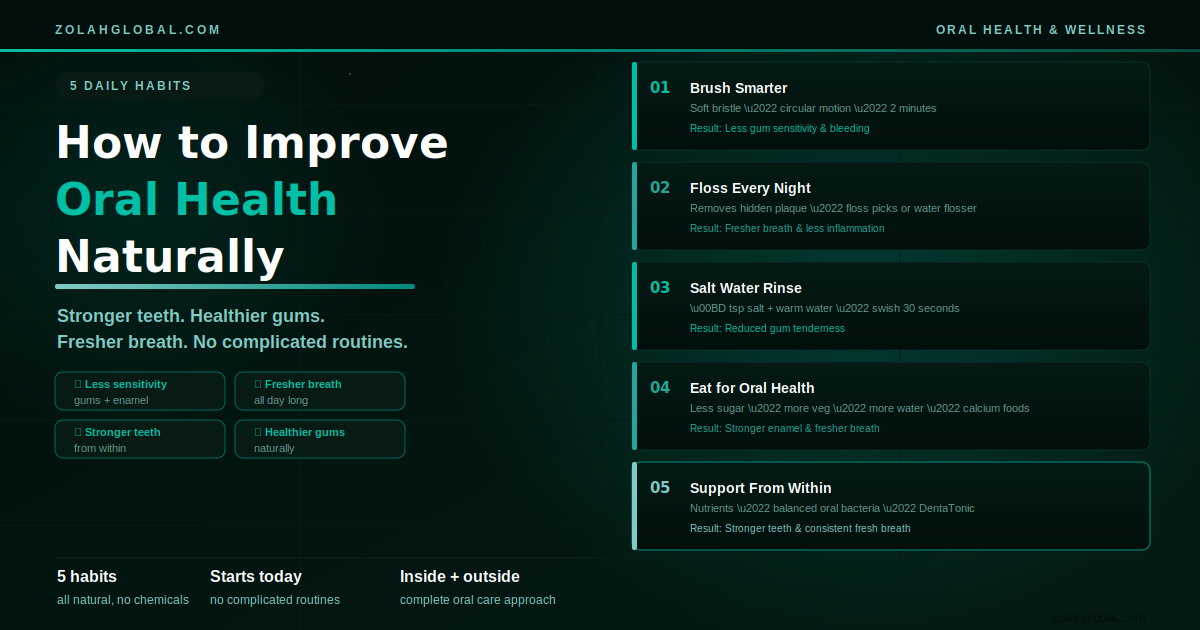
Habit 1: Brush Smarter — Not Just Longer
Most people are brushing their teeth in a way that actively damages them — and have no idea.
Aggressive scrubbing with a medium or hard-bristle brush feels thorough. In reality, it’s stripping enamel from the surface of your teeth and pushing your gum line upward — a process called gum recession that is largely irreversible. The harder you brush, the more vulnerable your teeth become to sensitivity, staining, and decay over time.
When I switched to a soft-bristle toothbrush and gentle circular motions — focusing on the gum line where bacteria accumulate — the change was noticeable within days. My gums felt less irritated. The bleeding when I flossed reduced significantly. The sensitivity I’d lived with for years started to ease.
The technique matters more than the duration. Two minutes of gentle, methodical brushing outperforms five minutes of aggressive scrubbing — every single time.
Pro tip: Set a 2-minute timer when you brush. Research shows the average person brushes for fewer than 45 seconds without realising it. Two full minutes, twice daily, is one of the most impactful ways to improve oral health naturally — and it costs nothing extra.
Habit 2: Make Flossing Non-Negotiable
If you’re skipping flossing — or doing it “occasionally” — you’re leaving up to 40% of each tooth’s surface completely uncleaned every single day.
Your toothbrush cannot physically reach the contact points between teeth. That’s where plaque accumulates undisturbed, where cavities form between teeth, and where the earliest stages of gum disease begin. Most people who develop periodontal problems are brushing consistently — they’re just not flossing.
I flossed “sometimes” for years. When I committed to every single night without exception, the change was remarkable within two weeks. Fresher breath in the morning. Less gum puffiness. A genuinely cleaner feeling that no amount of brushing alone had ever produced.
If traditional floss feels difficult or uncomfortable, floss picks or a water flosser remove the friction entirely — making consistency far easier to maintain long-term.
Pro tip: Floss before you brush — not after. When you floss first, you loosen plaque and food particles from between teeth, and then brushing sweeps them away while also allowing the fluoride in your toothpaste to penetrate between teeth more effectively. This sequence produces better results than either habit alone.
Habit 3: Rinse With Warm Salt Water
This is the oldest, simplest, and most underrated oral health habit available — and it costs pennies.
A warm salt water rinse creates a temporarily alkaline environment in your mouth that bacteria struggle to survive in. It soothes irritated gum tissue, supports the healing of minor inflammation, reduces harmful bacteria load, and neutralises the acids produced by food and drink that slowly erode your enamel over time.
The recipe: ½ teaspoon of sea salt dissolved in a cup of warm water. Swish gently for 30 seconds, then spit. Two to three times per week is enough to see results — daily use during periods of gum sensitivity is even more effective.
Within the first two weeks of adding this to my routine, gum tenderness I’d accepted as normal reduced noticeably. It wasn’t dramatic — it was gradual, then suddenly obvious. “This simple rinse is one of the most accessible ways to improve oral health naturally — no products required, just consistency.”
Pro tip: Do your salt water rinse after meals when possible. Food — especially acidic foods like citrus, coffee, and soda — temporarily softens enamel and creates conditions where bacteria thrive. A post-meal rinse neutralises those acids within minutes, protecting your enamel during its most vulnerable window.
Habit 4: Eat and Drink for Your Oral Health
Your mouth is not separate from your body — and your diet shows up in your oral health before it shows up almost anywhere else.
Sugar feeds the specific bacteria (Streptococcus mutans) that produce the acids responsible for enamel erosion and cavities. Sticky, sweet foods hold those bacteria against your teeth for extended periods. Frequent soda — even diet soda — creates a chronically acidic oral environment that slowly demineralises enamel over months and years.
The changes I made weren’t dramatic — I didn’t eliminate anything completely. I just shifted the balance: less sugar and fewer acidic drinks, more water, more crunchy vegetables, more calcium-rich foods. Carrots and celery act as natural tooth scrubbers. Water washes away food particles and stimulates saliva production — your body’s own built-in oral defence system. Calcium from cheese, leafy greens, and almonds directly remineralises enamel.
The results: fewer afternoon cravings for sweets (your palate actually adjusts within weeks), noticeably fresher breath throughout the day, and a mouth that felt cleaner between brushings. Adjusting what you eat and drink is one of the most overlooked ways to improve oral health naturally — and one of the fastest to show results.”

Pro tip: Cheese, leafy greens, and almonds are three of the most tooth-friendly snacks you can add to your daily routine. They’re alkaline, calcium-rich, and require chewing — which stimulates saliva and scrubs surfaces naturally. Swap one sugary snack daily with one of these three and notice the difference within a month.
Habit 5: Support Your Oral Health From Within
This is the habit most oral care routines never mention — and the one that made everything else work better.
Your gums and teeth are living biological tissue. They depend on a continuous supply of nutrients, a balanced oral microbiome, and an immune environment that supports healing and prevents inflammation. When any of those systems are depleted — through poor diet, stress, age, or nutritional gaps — your gums become more susceptible to inflammation, your enamel weakens, and your breath suffers regardless of how well you brush.
External habits clean the surface. Internal support nourishes the tissue beneath it.
When I added DentaTonic to my daily routine — a supplement formulated with natural ingredients to support healthy gum tissue, promote a balanced oral bacterial environment, and strengthen oral wellness from the inside — the shift over the following weeks was unlike anything a toothpaste or mouthwash had produced. Gums that had been persistently puffy began looking healthier. The sensitivity that flared with cold food eased. My breath stayed fresher longer.
This doesn’t replace brushing or flossing. It completes the routine — targeting the biological layer that topical products simply cannot reach.
Pro tip: Think of internal oral support as the foundation of your oral health — your daily brushing and flossing habits are the structure built on top of it. A strong foundation makes everything else more effective. A weak one limits what surface habits can achieve, no matter how consistent you are.
Ready to Add the Internal Layer That Makes Every Other Habit Work Harder?
You can brush perfectly, floss nightly, and rinse with salt water — and still leave the deeper biological layer of your oral health completely unaddressed.
Formulated specifically to support the gum tissue, oral microbiome balance, and enamel strength that topical products can’t reach — DentaTonic is the missing piece in most people’s oral health routine. Pair it with the 5 habits in this guide and address your oral health from every angle simultaneously.
How to Improve Oral Health Naturally: Quick Reference
| # | Habit | Key Benefit | When to Do It |
|---|---|---|---|
| 1 | Brush smarter | Less sensitivity, less bleeding | Morning + before bed, 2 min |
| 2 | Floss daily | Removes hidden plaque between teeth | Every night before brushing |
| 3 | Salt water rinse | Soothes gums, neutralises acids | 2–3 times per week |
| 4 | Eat for oral health | Stronger enamel, fresher breath | Every meal, every day |
| 5 | Internal support | Nourishes gums and teeth from within | Daily with your routine |
Does Improving Oral Health Naturally Actually Work?
Yes — when you address it from both the outside and the inside simultaneously.
That’s the combination most routines miss entirely. Brushing and flossing manage what’s on the surface. Diet reduces the inputs that damage your teeth. Salt water creates a healing environment. And internal support nourishes the living tissue beneath the surface that determines long-term gum health, enamel strength, and breath freshness.
None of these habits is complicated. None requires expensive equipment or a dentist appointment to start. They just require consistency over time — and the understanding that oral health is a whole-body system, not just a twice-daily hygiene task.
Your smile reflects your daily choices. And small habits truly do add up.
Final Thoughts: Start With One Habit Today
Knowing how to improve oral health naturally comes down to one principle: consistency over complexity.
You don’t need to implement all five habits at once. Start with the one that feels most manageable — better brushing technique, nightly flossing, or the salt water rinse — and build from there. Add one habit per week. By the end of the month you’ll have a complete routine that addresses your oral health from every angle.
Give it 30 days. The difference will be visible — and your dentist will notice too.
Take the Complete Approach to Your Oral Health — Starting Today
You now have the full external routine. The only piece left is adding the internal support that makes every other habit more effective.
👉 Add DentaTonic to Your Daily Routine — Click Here Before Supply Runs Out
Join thousands of people who stopped settling for sensitivity, bad breath, and inflamed gums — and finally gave their oral health the complete support it deserves. Inside and out. Starting today.
Disclaimer: This article reflects personal experience and is for informational purposes only. It does not constitute dental or medical advice. Always consult a qualified dental professional for diagnosis and treatment of oral health conditions.
Disclosure: This post contains affiliate links. If you purchase through our link, we may earn a small commission at no extra cost to you. We only recommend products we believe deliver genuine value.